Two amateur astronomers used OpenAI’s AI tools to search old NASA space telescope data for new planets. An expert has since independently confirmed two of their finds, though it’s still unclear whether any planets are actually there.
Kevin Bond, an OpenAI engineer and amateur astrophotographer, and Ethan Byrd, founder of the email startup Primitive, searched independently for exoplanets. Both used OpenAI’s AI tools and publicly available data from NASA telescopes.
They looked for transits: when a planet crosses in front of its star from Earth’s vantage point, it blocks a tiny fraction of the star’s light. That shows up as a small dip in the star’s light curve. If the dip repeats at regular intervals, a planet could be the cause.
Bond’s Codex pipeline spots two standout stars in Kepler data
Bond had Codex compare published search methods, combine them into a single program, and test whether code changes improved the search. One AI agent scanned the light curves of about 100,000 stars from the Kepler mission, which ran from 2009 to 2018. A second agent examined the flagged candidates more closely. The program reported more than 200 signals, including 10 from planets confirmed earlier.
Two stars stood out: KIC 5689121, in the constellation Lyra, is cooler than the sun and about half its size. Its light dips every 13.8 days, and a possible planet would be about 2.4 times Earth’s diameter. For KIC 6691030 in the northern sky, the dip repeats every 4.8 days. That would fit a planet smaller than Neptune.
An astronomer at the SETI Institute found both signals in a separate search. Vishal Gajjar, who oversees international SETI programs there, says Bond’s pipeline turned up candidates that conventional searches may have missed. In his view, the initial checks are encouraging, but follow-up observations will have to show what is behind the signals. That can take months or years, OpenAI says.
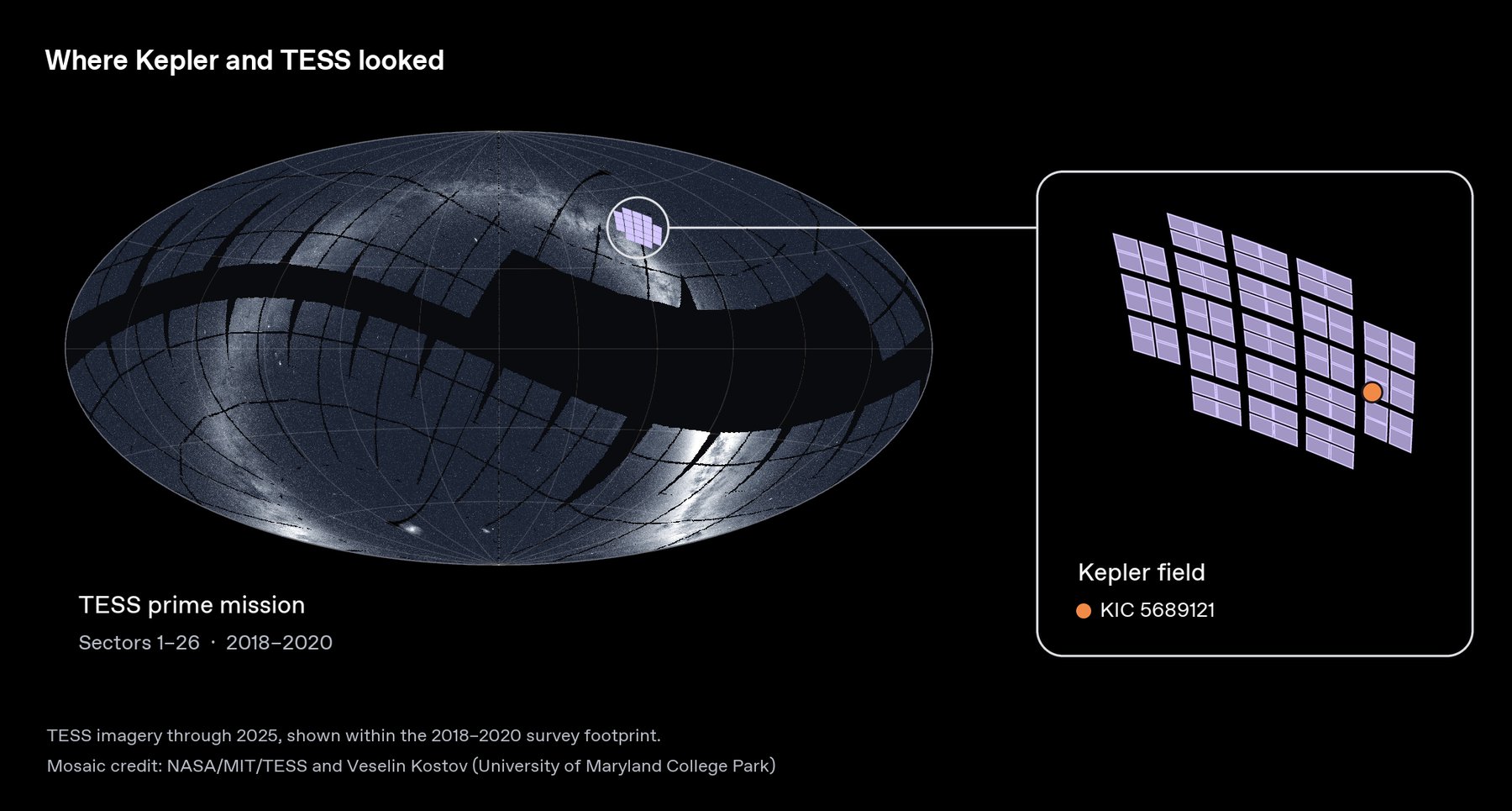 Kepler observed a single patch of sky for four years, while TESS observed nearly the entire sky. | Image: OpenAIGPT-6.2 Astra filters 49 candidates from 19 million stars
Byrd had GPT-6.2 Astra design two searches, one looking broadly for planet candidates and the other focused only on the habitable zone. That is the range of distances from a star where a planet with the right atmosphere could hold liquid water. GPT-6.2 Astra reviewed the scientific literature, wrote the software, and ran initial checks. The data on about 19 million stars came from NASA’s TESS satellite, launched in 2018, and other public archives.
The Decoder newsletter
The AI week in five minutes
Every week, our editors pick the AI news that matters. No hype, no spam.
Free and weekly. Unsubscribe any time.
The first run turned up 49 candidates. Byrd sent one of the strongest to TESS mission researchers, who now plan to take a closer look at it. He intends to submit two more, and his search is still underway.
Binary stars and instrument errors can mimic planet signals
A dip in starlight doesn’t prove a planet is there, because two stars eclipsing each other produce similar signals. Temperature swings aboard a telescope can affect its instruments and make a star look dimmer. Astronomers vet candidates statistically or follow up with other methods. The radial velocity method, for instance, measures how strongly a planet’s gravity tugs its star back and forth.
Astronomers have been using AI to hunt for planets for years. In 2017, researchers trained a neural network on 15,000 vetted Kepler signals and found an eighth planet around the star Kepler-90. More than 6,400 exoplanets have been confirmed so far. The SETI Institute and Breakthrough Listen use AI agents to operate the Allen Telescope Array in Northern California and apply AI models to incoming radio signals. NASA and IBM released a foundation model for lunar research. The model draws on 17 years of Lunar Reconnaissance Orbiter data to look for water ice at the poles.
OpenAI launched GPT-6.2 Astra in mid-November and markets it as “the world’s best model for scientists.” The model recently produced a machine-verifiable proof of a math theorem without human intervention.