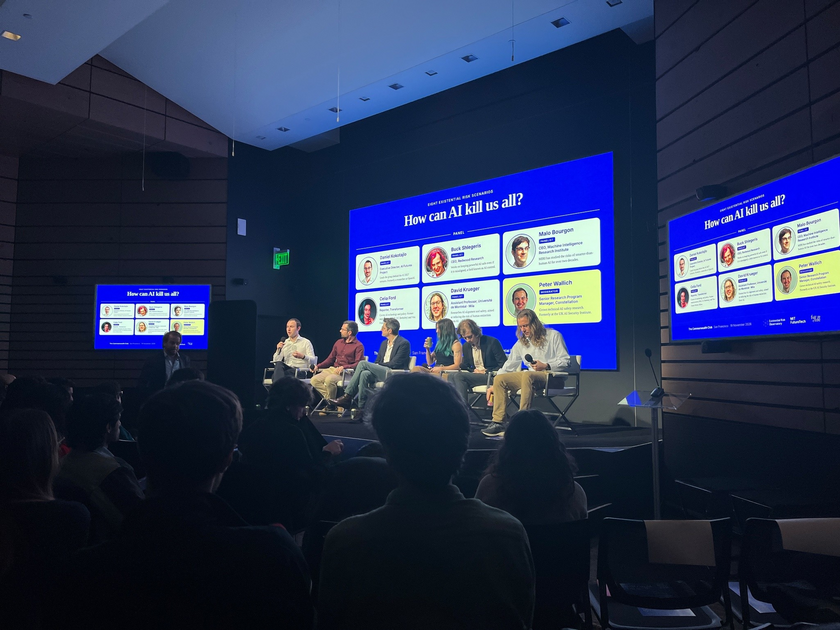
On the day Anthropic made its Wall Street debut, more than 100 people gathered at the Commonwealth Club in downtown San Francisco to hear a less celebratory assessment of AI’s potential: It could end humanity.
Many of the speakers argued for a moratorium on AI development, at least until labs learn how to train AI safely. Among them were Buck Shlegeris, CEO of Redwood Research; Daniel Kokotajlo, OpenAI whistleblower and author of the famous doomsday forecast “AI 2027″; and Malo Bourgon, CEO of the Machine Intelligence Research Institute.
Some local AI safety nonprofits, many of them based at Berkeley, are pressing the incoming Democratic majority in Congress to pass the country’s first comprehensive federal AI law.
At the event, the Dutch nonprofit Existential Risk Observatory laid out eight (opens in new tab) scenarios in which AI could bring about humanity’s demise or permanently deprive us of control over our future. The list of scenarios was drawn up by more than a dozen researchers from AI safety nonprofits and universities, including MIT, from a review of more than 3,000 papers, reports, and forum posts. It includes a rogue AI taking over the world, a world war fought with autonomous weapons, and a future in which we slowly turn into the humans of “WALL-E”: just chilling in our floating chairs while AI runs everything, too dependent to ever take back control.
Hugo Save, a researcher at the Existential Risk Observatory and the review’s lead author, told the Standard that their objective was to broaden the conversation beyond the classic “Terminator” scenario.
“If ‘rogue AI’ is the only perspective we have, we might miss addressing other potential catastrophes,” Save said. “These differences matter for how we respond, because some measures that help with one scenario can make another worse. Making AI reliably do what it’s told may help against a takeover, but it could also help someone seize power.”
To explain how the technology could threaten humanity, organizers opened with Geoffrey Hinton, the Nobel laureate in physics whose work laid the groundwork for today’s chatbots and agents. Speaking via Zoom, Hinton explained why he fears the technology he helped unleash. He quit a position at Google in 2023 so he could speak more freely about its dangers.
Existential Risk Observatory’s eight scenarios fall into three groups, and not all of them end with everyone dead. In the first group, humans lose power to AI, willingly or not.
• A single rogue AI outsmarts everyone and takes over the world.
• Many AI systems separately gain power, until together they are beyond our control.
• Many AI systems team up to take over.
• We slowly hand the keys to AI until we become effectively useless.
In the second group, AI helps a handful of humans become all-powerful.
• A government, company, or military uses AI to create a sort of Big Brother.
• AI takes our jobs, human labor becomes worthless, and whoever owns the machines runs the entire economy.
In the third, AI just makes us better at destroying ourselves.
• AI creates a bomb or disease that can wipe us out.
• A global war between rival superpowers spirals out of control as autonomous weapons call the shots.
Hinton said the danger comes from the way labs are training models. They use a technique known as reinforcement learning, in which the models learn by trial and error and are rewarded for successful behavior, much like a dog learning tricks for treats.
“We’re training these models to achieve goals any way possible,” Hinton said. Doing so, he argued, teaches them to be extremely competitive and to care only about the ends, not the means. And it’s all happening, he said, in an extremely competitive environment, as companies and countries race to build ever more powerful models.
“The enormous financial incentives to develop increasingly powerful AI systems are only accelerating the development of a technology we do not know how to control,” David Krueger, an AI professor at the University of Montreal and founder of the AI risk advocacy nonprofit Evitable, told the Standard the day before the IPO. Krueger was among the invited panelists.
To Hinton, the way out of these doomsday futures starts with seeing AI not as a tool but as a being.
“We should be asking ourselves what kind of being we want,” Hinton said. Rather than creating something like a child who only cares about itself, the labs should teach the models to be like mothers who care about their offspring — in this case, their human creators.
“Our main hope is to suppress the nasty tendencies we’re teaching them,” he said.