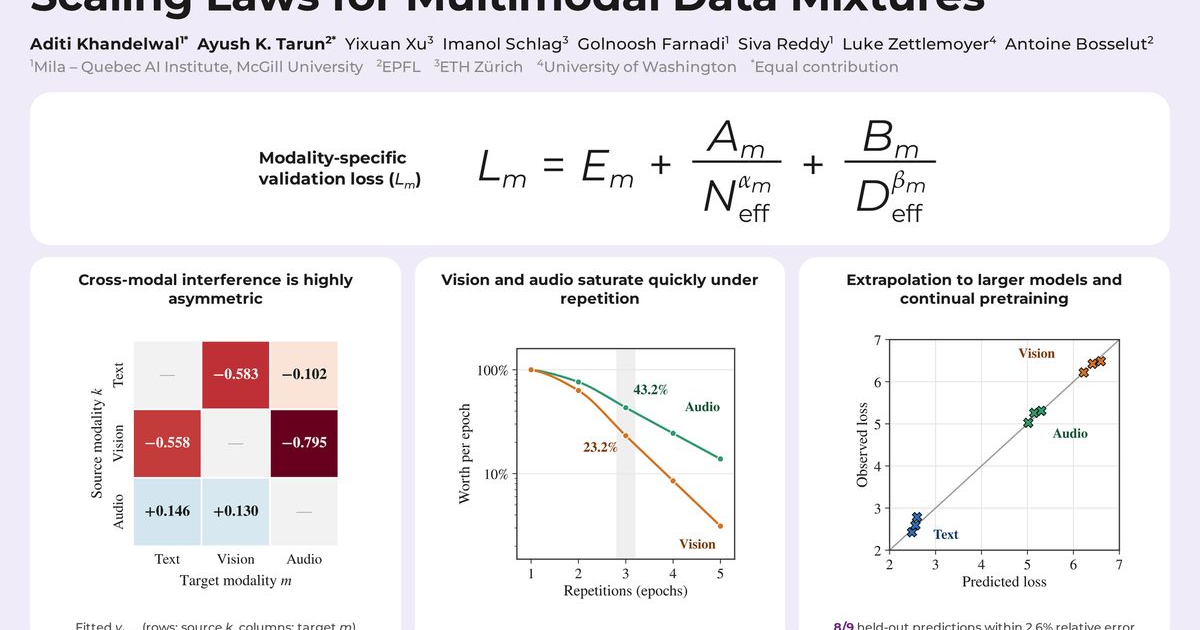
Researchers behind “Scaling Laws for Multimodal Data Mixtures” say they fit one scaling law to 268 mixture-of-experts (MoE) pretraining runs, spanning 457 million to 8.3 billion parameters. @Aditi184 announced the work on November 23, 2026, describing it as a NeurIPS 2026 Spotlight. Source
The work asks how to mix text, vision and audio when pretraining a multimodal language model. Source
In a November 24 quote-post of the announcement, @sivareddyg says text and vision favor balancing larger models with more training data, while audio favors putting more weight on model size. The post gives no numerical split. Source
The summary also describes asymmetric interference in the reported experiments: “vision strongly hurts audio; audio barely affects the others.” Audio, in this account, gets the rough end of the exchange. Source
Text is described as more tolerant of repeated training data. This is not an unlimited-text-refills policy. Source
The captured announcement and summary don’t provide the equation, fit quality, datasets, evaluation metrics or effect sizes. They also leave experimental conditions, repetition thresholds and an optimal text/vision/audio mixture ratio unspecified. The parameter range isn’t identified as active or total MoE parameters. SourceSource