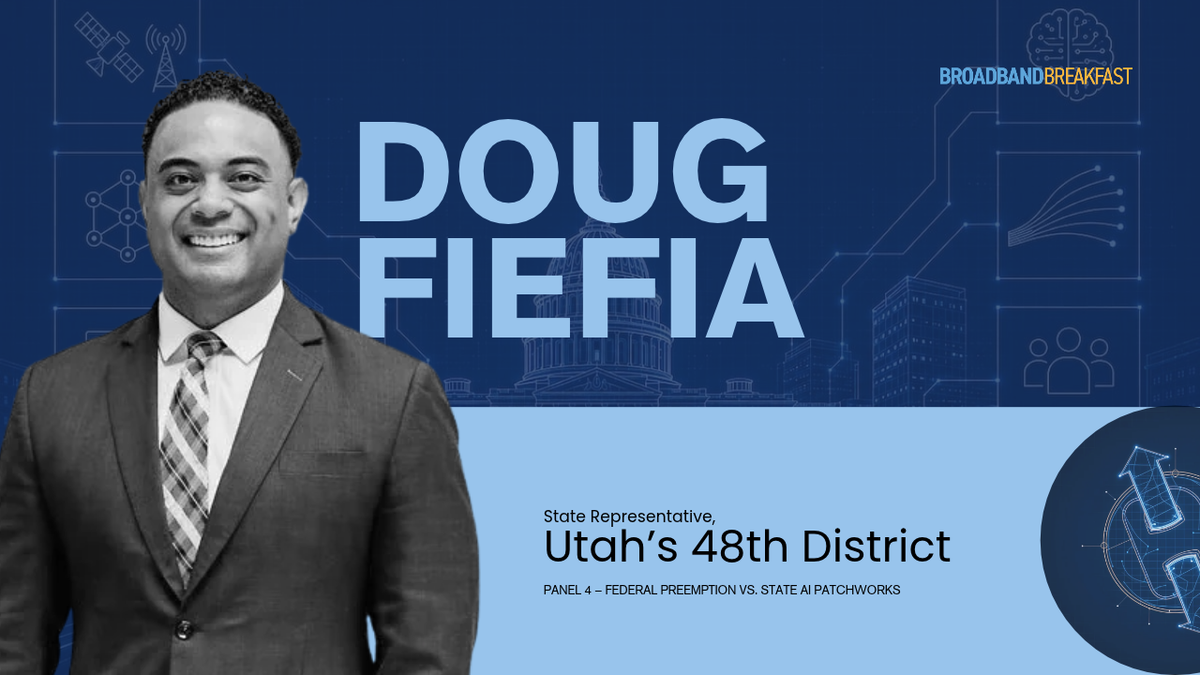
WASHINGTON, Nov. 29, 2026 – A Republican White House helped stop a Republican’s AI safety bill in Utah this year. The lawmaker who wrote it unseated a sitting state senator in June and now comes to Washington for a debate over whether states should keep writing AI rules.
Utah State Republican Rep. Doug Fiefia, senator-elect for Senate District 18, joins the 3 p.m. Dec. 1 panel, “Federal Preemption vs. State AI Patchworks,” at Broadband and AI in the Next Congress. Rebecca Kern, senior correspondent at the subscription policy news service The Capitol Forum, moderates.


The bill the administration opposed
HB 286, Utah’s proposed AI Transparency Act, reached developers that train models above 10^26 operations, with the heaviest duties on those earning at least $500 million a year.
Those large developers would have published a public safety plan and, for chatbots with 1 million monthly users that minors could foreseeably reach, a child protection plan. Safety incidents would go to the state’s Office of Artificial Intelligence Policy within 15 days. Whistleblowers would have gained a right to sue.
On Feb. 12, the White House Office of Intergovernmental Affairs wrote to Utah Senate Majority Leader Kirk Cullimore Jr., R, that “we are categorically opposed to Utah HB 286 and view it as an unfixable bill,” the tech news site The Next Web reported. The bill cleared a House committee without dissent, then died in the Senate.
A data rights record
A former technology sales manager at the business software company Workday and at Google, Fiefia is a first-generation American whose parents came from Tonga. He had represented Utah House District 48 since January 2025.
His first-year bill created the Utah Digital Choice Act, which requires social media services to let users take their data, including their social graph, to rival services through an open protocol. A 2026 follow-up moved its start date to July 1, 2027.
On preemption, a Republican dissent
Among the signers of a June 16 letter from 203 state lawmakers in 42 states was Fiefia. It opposed a three-year freeze on state AI laws in the Great American AI Act, a House discussion draft, warning that “the tech industry will almost certainly weaponize such a provision in court to strike down state measures.”
With Vermont Rep. Monique Priestley, D, he co-chairs the National Task Force on State AI Policy at Future Caucus, a nonprofit network of younger lawmakers. “There’s concern about this state patchwork of laws, but that’s why we’re coming together,” he told Pluribus News in October 2025.
The House’s FRONTIER Act, H.R. 9925, from Reps. Jay Obernolte, R-Calif., and Lori Trahan, D-Mass., uses the same 10^26 threshold. Its Section 9(b) would bar state obligations on developers in risk transparency, audits and incident reporting, the core of HB 286. A savings clause keeps state rules protecting minors, and Trahan’s Nov. 19 section-by-section would let more protective state laws stand.
The Senate seat came through a June 23 primary in which Fiefia beat Sen. Dan McCay, R, 69.5 percent to 30.5 percent.
What to watch at ‘Broadband and AI in the Next Congress’Will Fiefia bring a frontier AI bill to the Utah Senate in 2027, and would Section 9(b) void it?Would a federal floor shield a bill like HB 286 from the kind of opposition it met in February?Does the child-safety carve-out in federal proposals leave room for Utah’s chatbot rules?
Sign up for Broadband and AI in the Next Congress on Dec. 1.