Study design and methodological framework
This study was designed as a methodological, evaluation-oriented investigation examining whether artificial intelligence (AI) systems can apply predefined biomedical interpretive criteria to visual materials in a reproducible, internally consistent manner, and whether these evaluations differ from heterogeneous human reference judgments. The objective was not to assess diagnostic performance or model accuracy, but to evaluate the feasibility of operationalizing biological interpretability as a measurable construct. The study was conducted as a controlled experimental evaluation using standardized visual stimuli and a predefined instrument; human involvement was limited to methodological operations (image selection, standardized interaction with AI interfaces, independent reference scoring), with no patient data, clinical material, or personal data involved.
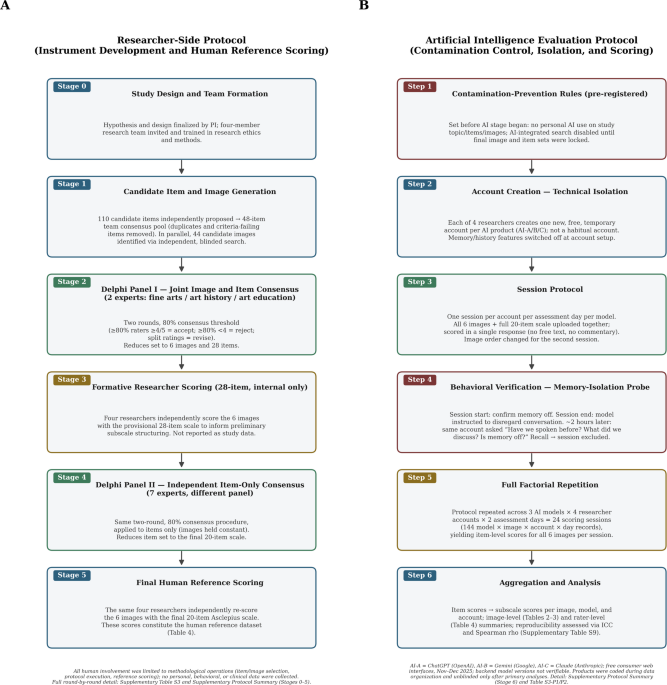
A repeated-measures design evaluated the same visual stimuli across multiple AI models, independent researcher-operated accounts, and two assessment days, enabling assessment of within-image, within-model, within-operator, and within-day variability while minimizing contextual dependency and systematic bias (Fig. 1). This design prioritized protocol control, score reproducibility, and internal consistency assessment over broad stimulus-level generalizability.
Fig. 1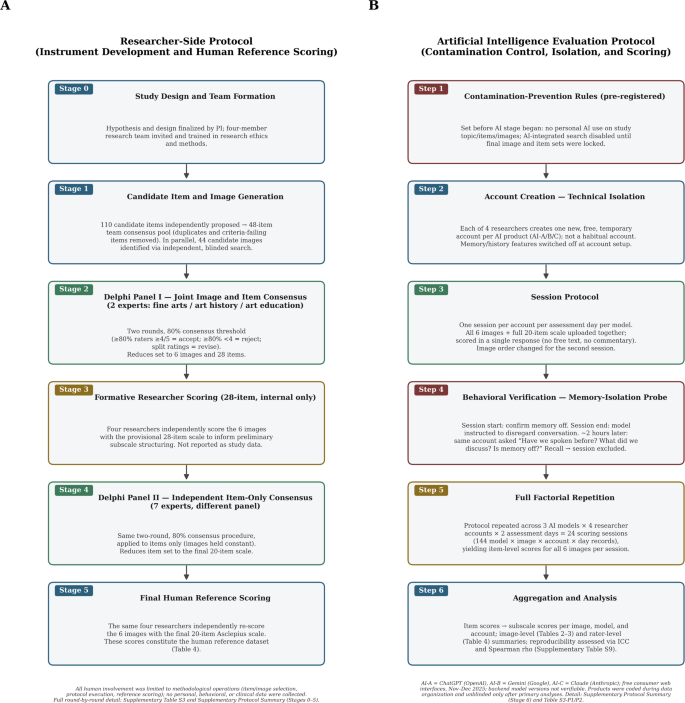
Methodological Pipeline: Researcher-Side Protocol and AI Evaluation Protocol. (A) Researcher-side protocol (Stages 0–5): study design and team formation; candidate item and image generation (110 proposed items → 48-item pool; 44 candidate images); Delphi Panel I (2 experts; joint image and item consensus → 6 images, 28 items); formative researcher scoring (28-item, internal only); Delphi Panel II (7 experts; independent item-only consensus → final 20-item scale); and final human reference scoring, which constitutes the dataset reported in Table 4. (B) AI evaluation protocol (Stage 6): contamination-prevention rules established prior to the AI stage; account creation with account-level technical memory isolation; the standardized single-session scoring protocol (all six images and the 20-item scale per session); the behavioral memory-isolation verification probe administered approximately two hours after each session; the full factorial repetition across 3 AI models × 4 researcher-operated accounts × 2 assessment days; and aggregation into the subscale scores reported in Tables 2, 3 and 4. Full procedural detail for both panels is provided in the Supplementary Protocol Summary and Supplementary Table S3.
Visual stimuli selection, human reference framework, and experimental controls
Visual stimuli were selected through a structured, multi-stage process conducted prior to AI evaluation, performed exclusively by the four researchers, none of whom had formal training in visual or fine arts, to approximate non-expert interpretation and minimize bias from prior art-historical familiarity. We intentionally selected artworks permitting multiple plausible interpretive pathways rather than conventional medical illustrations, providing a stringent test of whether biological interpretability could be operationalized under conditions of interpretive ambiguity. Each researcher independently searched public-domain image archives against predefined eligibility criteria (public-domain status, no copyright restriction, prior discussion in health-related academic or medical humanities literature); candidate images were pooled and discussed. Because several images were nominated by more than one researcher, researcher-level nomination counts are not additive with the number of unique images evaluated: 44 nominations were submitted, and overlapping nominations were consolidated before Round 2, yielding 28 unique images. Two images on which researchers disagreed regarding health relevance were intentionally retained as control stimuli, to test the instrument’s ability to discriminate clearly health-themed from more ambiguous images. Full round-by-round selection detail is in Supplementary Table S3 (Part B), the Supplementary Protocol Summary, and Supplementary Figure S1.
Six paintings were selected: four classified a priori as health-themed (documented associations with physical illness, psychological distress, or bodily suffering) and two as control stimuli (Table 1; identification, archive URLs, and copyright status in Supplementary Table S1). Images were presented in their original format without modification. The images themselves are not reproduced in this article; each stimulus can be viewed at the archive/access URL listed in Supplementary Table S1, which also documents its jurisdiction-specific copyright status (the two works by Frida Kahlo, P2 and P5, are in the public domain under life + 70-year terms but remain under copyright in Mexico). This limited, theory-informed stimulus set reflects an intentional early-stage design choice prioritizing repeated evaluation across models, operators, and days over maximizing image number, strengthening protocol stability and minimizing contextual carryover.
Table 1 Visual stimuli and classification.Artificial intelligence models and blinding strategy
Three publicly available multimodal AI models were used and coded as AI-A, AI-B, and AI-C, selected for multimodal visual-textual processing capability, public accessibility, representation of different development ecosystems, and suitability for standardized, repeatable evaluation, reflecting widely used general-purpose systems rather than specialized or fine-tuned tools. Model identities were coded during data organization and initial statistical modeling to minimize expectancy effects; because interfaces were recognizable during operational use, blinding was applied at the level of data coding, aggregation, and initial model-level analysis rather than interface interaction, with unblinding performed only after primary analyses. Each model was accessed through independent researcher-operated accounts using default public-access interfaces; no paid enterprise-level, customized, or fine-tuned systems were used. The models were accessed through the free consumer web interfaces of ChatGPT (OpenAI; AI-A), Gemini (Google; AI-B), and Claude (Anthropic; AI-C) between 21 November and 11 December 2025 (Supplementary Table S3-P1). Because these consumer interfaces did not display a verifiable backend model version at the time of access and no contemporaneous interface records of version labels were retained, the models are identified by product, provider, interface, account type, and access date rather than by a specific model release.
Researchers, role definition, and operator independence
Four independent researchers participated in data acquisition, differing in age, gender, and educational background (a secondary school student, a retired primary school teacher, a dentist, and a professor with clinical-biological research expertise outside visual arts), representing heterogeneous non-specialist evaluators rather than domain-specific art experts. Researchers held three predefined, non-overlapping roles—independent image selection, operational execution of AI interfaces, and independent human reference scoring—and were not involved in statistical modeling, a separation implemented to reduce observer and confirmation bias. Internal human reference scores were not treated as ground truth, validation targets, or outcome variables, but used solely for methodological comparison illustrating human interpretive variability relative to AI score stability; this internal panel does not constitute an independent, representative, or blinded human sample, and is reported to illustrate relative variability, not to establish criterion validity.
Development of the biological interpretability instrument
The instrument was developed to operationalize biological interpretability as the degree to which a visual stimulus can be plausibly interpreted through established biomedical mechanisms, grounded in measurement theory and informed by biopsychosocial medicine, disease pathophysiology, neurobiology, psychopathology, and medical humanities12, yielding four theoretically distinct subscales: Physical Disease Biology, Mental/Psychiatric Disease Biology, Integrated Biopsychological Representation, and Non-Medical Interpretability Table 2 and 3.
Table 2 Comparison of health-themed and control images across artificial intelligence models and biological interpretability subscales.Table 3 Image-level comparison of health-themed and control images across biological interpretability subscales (pooled across AI-A, AI-B, and AI-C).
Candidate items and images were generated independently by the four researchers. From 110 proposed items, 22 duplicates and 26 items not meeting predefined criteria were removed; the remainder was revised across two team meetings, yielding a 48-item consensus pool, alongside 44 candidate images identified independently. This pool was evaluated jointly by a first modified-Delphi panel (Panel I: two independent experts in fine arts, art history, or art education with a PubMed-indexed research record) over two rounds, applying a predefined 80% consensus threshold (≥ 80% raters ≥ 4/5 = accept; ≥80% <4 = reject; split ratings = revise), yielding consensus on six images and a 28-item provisional scale. The four researchers then scored this provisional scale formatively (not reported as study data) before it was submitted to a second, independent Delphi panel (Panel II: one clinical psychologist, one psycho-oncologist, one medical ethics specialist, one Turkish language and literature expert, one general practitioner, one family physician, and one medical education academic; seven experts in total, none of whom were study authors), applying the same procedure and threshold to yield the final 20-item Asclepius Biological Interpretability Scale (Supplementary Table S2). Across the two panels, the candidate pool was reduced from 48 to 37 items (Panel I, Round 1), 28 (Panel I, Round 2), 22 (Panel II, Round 1), and 20 (Panel II, Round 2). Split-rated items were returned for revision; after Panel II Round 1, six split-rated items were eliminated at the research team’s reconciliation meeting because revision was not expected to resolve the disagreement. Full round-by-round Delphi data for both panels, including the status of every candidate item at each stage, are in Supplementary Tables S3 and S3-I and Supplementary Figure S2; the complete protocol narrative is in the Supplementary Protocol Summary. The same four researchers then independently re-scored the six images using this final scale, constituting the human reference dataset in Table 4. All items were scored on a five-point Likert scale (1 = very low/not applicable to 5 = very high).
Table 4 Rater-level comparison of researchers’ reference scores and artificial intelligence outputs across image groups.
Terminology is used consistently throughout: an item score is the 1–5 rating for a single item; a subscale score is the mean of item scores within a conceptual domain; a pooled score is a subscale score further averaged across the three AI models (Table 2); biological interpretability score refers collectively to the four subscale scores. Summed subscale totals are additionally reported alongside mean item scores in the open dataset (Supplementary Tables S4-S5 and the accompanying open-data workbook, Art and AI dataset.xlsx), so that all values in Tables 4 and Supplementary Table S9 are independently reproducible; mean item score is the metric used throughout the main text.
Assessment protocol and bias control procedures
Each researcher-operated account underwent one evaluation session per assessment day per AI model, in which all six images and the full 20-item scale were uploaded together and scored in a single session; image order was changed for the second session. Memory functions were disabled at the account level before any session began; at each session’s start the model confirmed memory was off and, from the second session onward, whether it recalled any prior interaction, before being instructed to treat the task as structured biomedical evaluation rather than artistic or symbolic interpretation—account-level technical isolation plus session-level verification together approximating rater independence across sessions.
The model assigned a single numerical score to each of the 20 items per image; free-text explanations and artistic commentary were explicitly prohibited to standardize scoring. At session end the model was instructed to disregard the conversation; approximately two hours later the same account was used to ask whether it recalled the prior conversation and whether memory was off. Sessions with reported recall at this delayed check would have been excluded; none met this criterion. This delayed-probe procedure is detailed in the Supplementary Protocol Summary (Stage 6), and was repeated across both assessment days and all three models.
Data structure and scale reliability
The study employed a fully crossed repeated-measures design (3 AI models × 6 images × 4 researcher-operated accounts × 2 assessment days = 144 scoring records); session metadata were verified against the original session records, and each factorial combination occurs exactly once in the dataset. This design produced a hierarchical dataset of item- and subscale-level observations nested within image, model, operator, and day. Internal consistency was assessed using Cronbach’s alpha across pooled AI-generated item responses; although ratings were AI-generated rather than human, this was considered appropriate because the models produced repeated, structured, quantifiable responses across multiple operators and sessions, with an alpha of ≥ 0.80 predefined as high internal consistency.
Statistical analysis
Item-level AI scores were averaged across assessment days for each image, model, and account, then aggregated within conceptual domains and further averaged across days and accounts, so reported values reflect model-level patterns independent of operator and temporal variation. The internal human reference scores were analyzed separately, summarized descriptively at the subscale level for methodological comparison only. Health-themed (P1-P4) and control (P5-P6) images were compared at the image level, because Image Type varies only between the six stimuli: for each image, subscale scores were averaged across accounts and days (Table 2, within each AI model) or across models, accounts, and days (Table 3), and differences were summarized as mean differences and image-level Cohen’s d (pooled between-image SD). These effect sizes are reported descriptively, without confidence intervals, because they rest on four health-themed and two control images. The accompanying p-values are from pooled-variance t-tests on the six image-level means (4 health-themed vs. 2 control images; df = 4) and are exploratory. No mixed-effects model was fitted: because the design is fully balanced and Image Type varies only between images, this image-level test corresponds to the between-image error stratum against which a model with Image ID as a random intercept would evaluate Image Type, so fitting such a model would not add information about this comparison. No model-specific tests, interaction terms, or post-hoc contrasts were performed, and Researcher Account and Assessment Day effects were not tested as mean-level effects but were examined through the reproducibility analyses described below. Because Image Type is defined by only six stimuli, these tests have very low power and are interpreted cautiously.
Human-AI comparisons were summarized descriptively at the rater level: each researcher (n = 4) and each AI model (n = 3) contributed one mean subscale score per image group, and differences are reported as mean differences with between-rater SDs (Table 4). No inferential tests, standardized effect sizes, or confidence intervals were computed for these comparisons, which are illustrative and do not position human judgments as external validity criteria. Score consistency across operators and days was assessed via Spearman correlation and the Intraclass Correlation Coefficient (ICC(A,1), two-way random-effects, absolute-agreement, single-measures), computed separately for accounts and days (Supplementary Table S9). Criterion validity was not assessed, as no accepted external reference standard exists for biological interpretability in visual materials; preliminary evidence was instead sought through expert-based item development, internal consistency, reproducibility, and within-sample discrimination in the development image set. Because the same six images were used during the Delphi evaluation of item suitability, this discrimination is a development-stage check rather than independent known-groups validation.
Ethics statement
This study used publicly available artworks and structured AI-generated outputs; no patient, personal, or clinical data were involved. Researchers were not study participants; the Delphi process involved external experts, not study authors, who participated voluntarily after being informed of the study’s purpose, with no personal or identifiable data collected from them. The Muğla Sıtkı Koçman University Medical and Health Sciences Ethics Committee determined that ethics approval was not required (Decision No: 10; 16 February 2026). In accordance with SAGER guidelines, sex and gender analysis was not applicable, as the study did not involve patient data or gender-based outcome variables; the demographic diversity of the researcher-operators is reported descriptively to characterize the non-specialist panel and was not used as a subgroup variable.
This disclosure concerns the use of generative AI in preparing this manuscript and is distinct from the AI models (AI-A, AI-B, AI-C) that constitute the study research subject, described above. Generative AI assistance (Claude, Anthropic) was used during manuscript preparation to support language editing and to assist in verifying and re-computing the statistical analyses in the open-data workbook, under full author review and verification. No generative AI tool is credited as an author, and no figures were generated by AI.