Daily briefFrom Yash · 350K+ students taught
Catch up on AI
One AI story explained in plain English, plus one thing to try. Every day, free. Unsubscribe anytime.
Aionic Labs co-founder Martin Maritsch reported on November 27, 2026 that fine-tuning OpenTSLM on AWS Trainium2 cost about half what a comparable H200 run cost at AWS list rates, while reaching similar loss with longer wall time. The claim spread after a Hacker News item summarized his post; the primary sources are his X thread and the AWS Machine Learning Blog from November 17, 2026.
TL;DR: claimed vs verified
ClaimStatusTrainium2 run $884 vs H200 $1816 at AWS standard ratesStated by Maritsch on X Nov 27, 2026Similar loss between runsStated by Maritsch; no public loss curves attached to the postTrainium2 1.5x slower wall time vs two-node H200Stated by Maritsch50% cheaper headlineArithmetic on his 884 vs 1816 numbers; not an AWS marketing claimApplies to all LLM trainingNot verified — single OpenTSLM recipe
What OpenTSLM is
OpenTSLM is Aionic Labs’ open time-series language model family. It pairs numerical sequences—sensor readings, IT telemetry, industrial metrics—with text context so operators can ask why a signal changed.
How OpenTSLM is wired on SageMaker
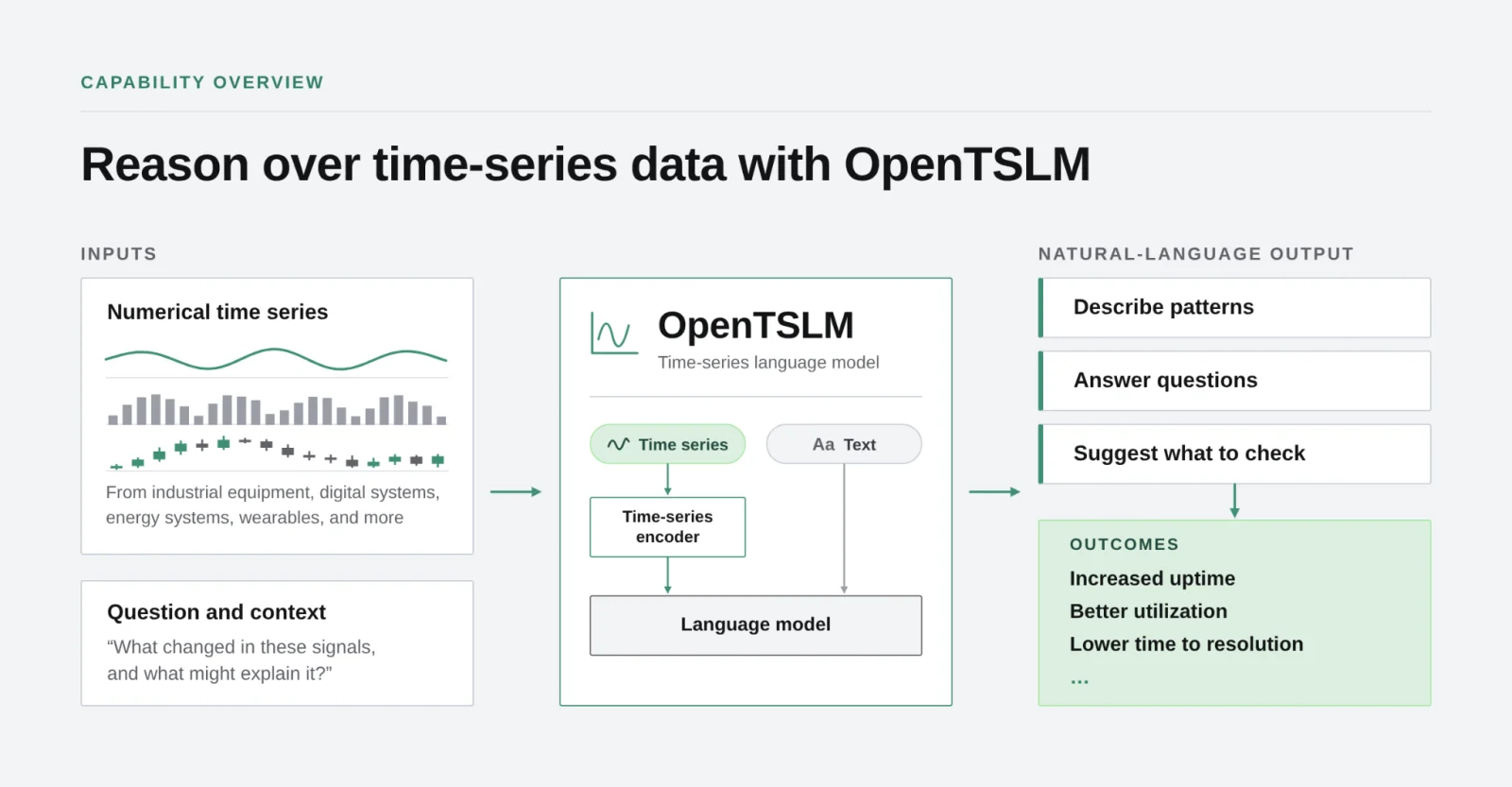 OpenTSLM architecture diagram for time-series language model on AWS Trainium2
Image: Amazon Web Services
AWS added OpenTSLM-Flamingo to SageMaker JumpStart in mid-November 2026. The blog post describes a Nexthink proactive IT support example: Spark combines device telemetry with employee context, then proposes checks and fixes.
That use case is narrower than generic chat LLM fine-tuning, which matters when you compare silicon.
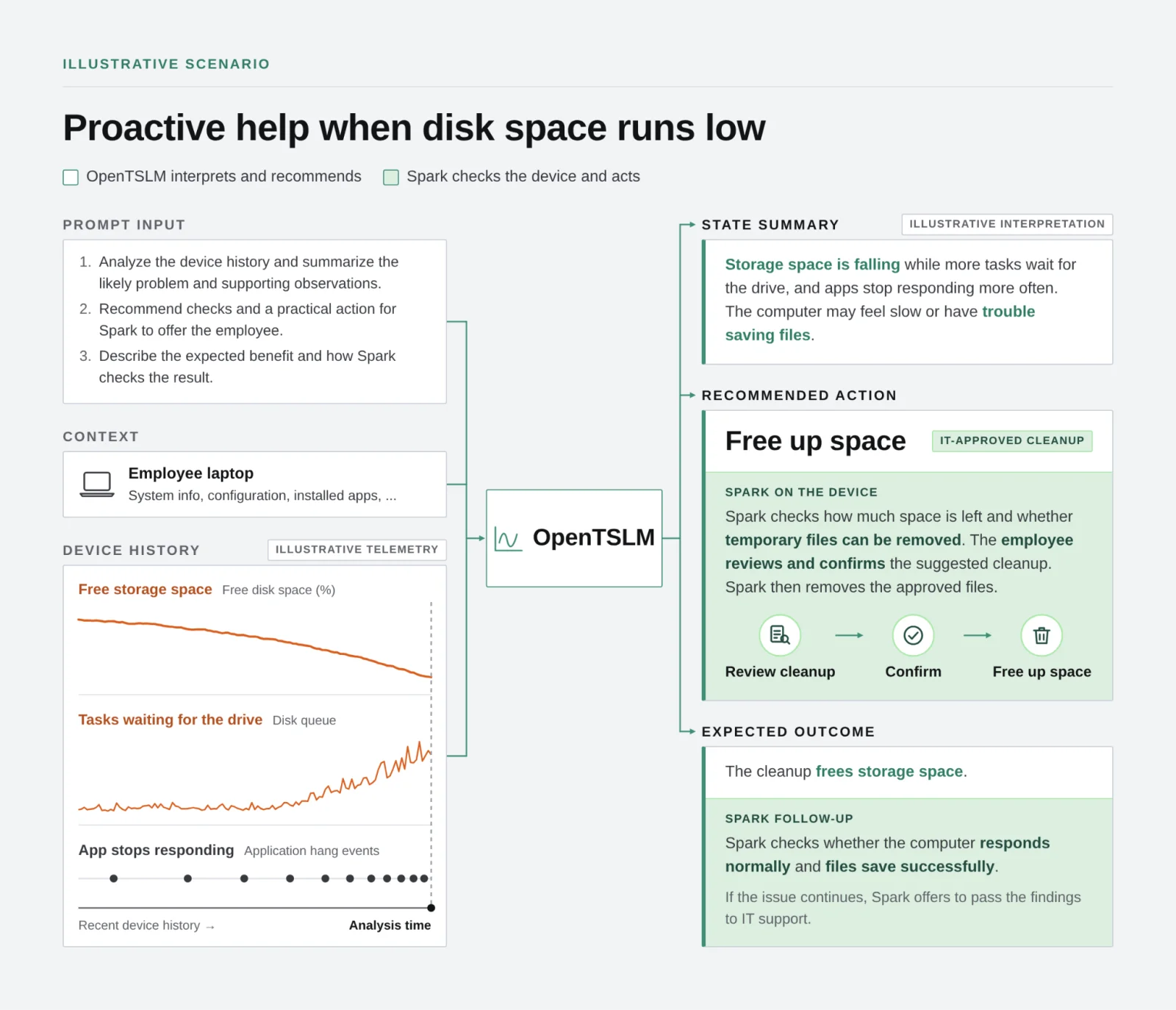 Nexthink Spark low-disk workflow diagram from AWS OpenTSLM blog
Image: Amazon Web Services
What Maritsch reported about Trainium2
In the November 27 X post Maritsch wrote that the team trained OpenTSLM with a Qwen3-4B backbone on Trainium2 and that it was 2x cheaper than NVIDIA H200s at AWS standard rates, with $884 vs $1816 for a full run. He added:
Loss was similar between runs.
One-node Trainium2 took about 1.5x as long as a two-node H200 job.
The Trainium2 port stayed in PyTorch with precompiled fixed batch shapes and 4-way tensor parallelism to fit the model on the chips.
A follow-up reply in the same thread points readers to the AWS blog for architecture detail.
None of these figures appear as a formal benchmark table on aws.amazon.com at publication time. They are one team’s training logs, not Amazon’s official price-performance claim.
How this differs from other Trainium2 headlines
explainx.ai already tracks narrow Trainium wins:
Maritsch’s post is closer to a fine-tuning bill of materials story: dollars per completed run, with explicit wall-time trade-offs.
When Trainium2 might save money
Use his checklist before you switch fleets:
Model fits Neuron stack — custom ports may need shape precompilation as he described.
You pay list or similar rates — enterprise discounts change the ratio.
Wall time is acceptable — slower jobs can still be cheaper per dollar if hourly rates differ enough.
You measure end-to-end — include data prep, checkpointing, and failed recompiles.
For inference-heavy teams, also read LTX 2.5 on Trainium3 for how AWS positions next-gen Trainium versus GPU media workloads—different axis from TSLM fine-tuning.
How to try OpenTSLM on AWS
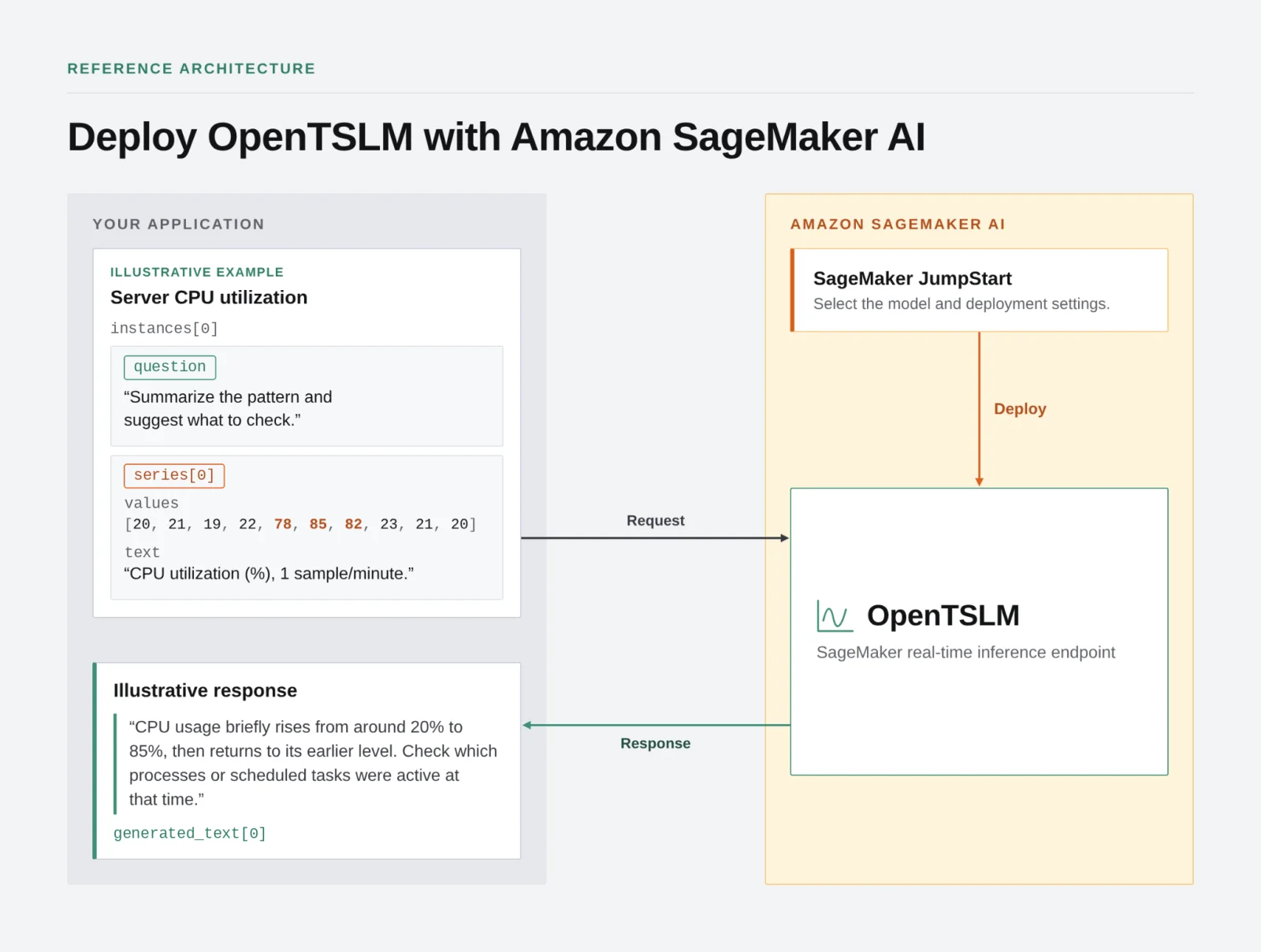 SageMaker JumpStart OpenTSLM deployment reference architecture from AWS
Image: Amazon Web Services
The AWS blog lists prerequisites: a SageMaker domain, execution role, and GPU instances for the JumpStart deployment walkthrough (ml.g6.2xlarge default). Fine-tuning steps in the tutorial use ml.g7e.2xlarge in the training-job example.
Outline:
Open SageMaker Studio → JumpStart and search OpenTSLM.
Accept the Gemma license terms on the deployment form if you deploy Flamingo variants tied to Gemma 3 4B.
Run the notebook that fine-tunes using TimeNet datasets if you want Aionic’s data path.
Log billed hours and final loss on your workload before comparing to H200 nodes.
Maritsch’s employer background includes AWS experience per his public bio, which does not invalidate the numbers but means he is not a disinterested observer.
What AWS documents about OpenTSLM costs separately
The November 17 AWS blog focuses on deployment and fine-tuning mechanics, not a Trainium versus H200 price chart. Still, it gives inputs for your spreadsheet:
OpenTSLM-Flamingo pairs Gemma 3 4B with a time-series encoder; total size about 5.24B parameters in bfloat16, roughly 10.5 GB weights for inference examples.
Default deployment example uses ml.g6.2xlarge (NVIDIA L4) for JumpStart endpoints—not Trainium—for the walkthrough.
Fine-tuning tutorial references ml.g7e.2xlarge for a training job with data loaded through TimeNet and artifacts in S3.
Maritsch’s November 27 numbers therefore describe a Neuron Trainium2 training path parallel to, not identical with, the GPU instance types in the blog screenshots. When you reproduce costs, tag each row with instance family, chip count, and billed hours.
Reading the Hacker News headline carefully
The HN submission title said Trainium2 cut training cost 50% compared to H200. Maritsch’s primary text says 2x cheaper, which is the same ratio stated differently, but the thread had no substantive comments at the time of our check—no independent replications to cite in a “What developers are saying” section.
Use the HN link only as a discovery path to the X post and AWS blog, not as proof.
A simple cost model template
Line itemTrainium2 run (per Maritsch)H200 run (per Maritsch)Stated total at list rates$884$1816Relative price~49% of H200 spendBaselineWall time~1.5x longer on one nodeFaster on two nodesLoss outcomeSimilar (author report)Similar (author report)WorkloadOpenTSLM Qwen3-4B fine-tuneSame workload
Add your own rows for data egress, checkpoint storage, failed jobs, and reserved-instance discounts before procurement adopts the ratio.
Neuron porting notes Maritsch mentioned
In a reply thread, Maritsch said the team kept PyTorch, precompiled fixed batch shapes, and used four-way tensor parallelism to fit the model on Trainium2. That pattern matches how other teams avoid Neuron recompile stalls—see the TRL Trainium padding default write-up for a related compile-time lesson on small SFT jobs.
If your workload has variable sequence lengths every step, your compile profile may differ from OpenTSLM’s fixed shapes, and dollar savings may shrink or disappear.
Enterprise buyers: questions for AWS account teams
Does your contract include Trainium2 capacity in the same region as your H100 pools?
Will SageMaker JumpStart jobs you run match the OpenTSLM recipe or a different model class?
Are Neuron versions pinned in your AMIs for reproducibility?
Who signs off on export or data residency when telemetry leaves your VPC for fine-tuning?
None of those appear in Maritsch’s tweet; they matter when a CFO asks for fleet-wide savings.
What developers should not conclude
Do not paste “50% off all training” into procurement slides from one tweet.
Do not assume two H200 nodes versus one Trainium2 node is a fair hardware match without normalizing chip count and memory.
Do rerun with your batch sizes—Maritsch emphasized precompiled shapes, which interacts with dynamic workloads differently than interactive LLM fine-tunes.
Time-series language models in one paragraph
Traditional LLM fine-tunes map text to text. TSLMs map numeric series plus text to text, which suits industrial telemetry, finance series, and IT device metrics. OpenTSLM therefore sits beside generic ChatGPT fine-tuning guides, not inside them.
The AWS blog’s Nexthink example shows three structured outputs—state summary, recommended action, expected outcome—so downstream automation can validate fixes. That product shape is closer to ITSM copilots than to marketing copy generators.
If your company already runs Muxlio-style durable agent workflows, TSLMs may eventually feed anomaly explanations into those graphs; Maritsch’s cost post is only the training bill for one model family.
Security and data handling
Time-series data often includes operational secrets: factory yields, patient monitors, trading flows, or employee laptop telemetry. JumpStart deployment keeps inference inside your VPC, but fine-tuning notebooks still need S3 buckets and IAM roles scoped to least privilege.
Maritsch’s public numbers do not describe encryption, retention, or customer data isolation. Treat those as standard cloud review items.
When to stay on H200 anyway
Stay on Nvidia if you already invested in CUDA-specific kernels, multi-node NCCL recipes, or third-party libraries without Neuron ports. Maritsch’s team had incentive to port OpenTSLM because they build the model; your team may not.
Also stay on H200 when time-to-train dominates dollar cost. His Trainium run was cheaper but slower; deadline-driven launches may prefer the two-node H200 path even at higher list spend.
Glossary for procurement slides
TermMeaning in this storyTrainium2AWS’s second-gen AI training accelerator familyNeuronAWS stack compiling PyTorch/JAX to TrainiumOpenTSLMAionic Labs open time-series language model familyJumpStartSageMaker hub for pretrained models and notebooksList rateAWS public on-demand price before enterprise discount