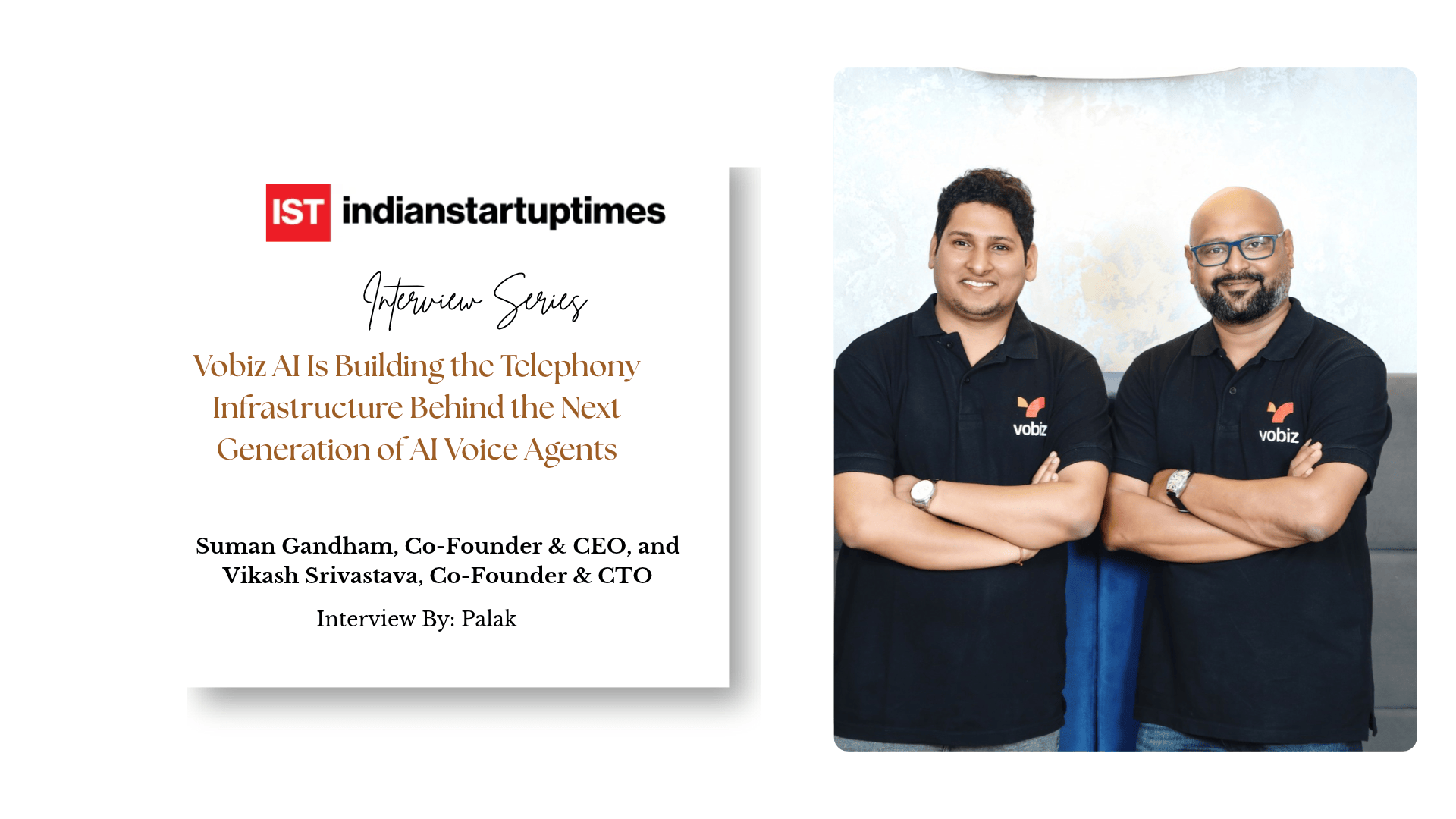
As Voice AI Advances, Infrastructure Remains a Critical Challenge
As artificial intelligence continues to transform customer interactions, voice AI is emerging as one of the most promising applications for businesses. From banking and financial services to e-commerce and customer support, AI-powered voice agents are increasingly being deployed to automate conversations at scale. However, while AI models are becoming more sophisticated, the infrastructure connecting these agents to real-world telephone networks remains a significant challenge.
For Suman Gandham, Co-Founder and CEO of Vobiz AI, this gap represents a larger opportunity in the evolving voice AI ecosystem.
Based in Bengaluru, Vobiz AI is building AI-native telephony infrastructure that connects voice agents with real phone networks through programmable voice APIs, SIP trunking and real-time audio streaming. The company aims to address critical challenges such as call latency, number provisioning, call quality, scalability and telecom compliance.
Gandham’s entrepreneurial journey has been closely connected to voice technology and financial services. His first two ventures were voice-based companies, both of which were eventually acquired. He later founded Finin, a consumer neobank that was acquired by Open. Following his departure from Open, he began building AI voice agents for the BFSI sector.
During this experience, he identified a recurring problem: AI models and voice agent demonstrations were improving, but actual deployments continued to face difficulties because of the underlying telephony infrastructure.
“The models kept improving. The demos kept improving. But the deployments kept stalling in the same place — the call itself,” Gandham explains.
After speaking with multiple teams developing voice agents, he realised that the problem extended beyond his own projects. Developers across the ecosystem were struggling to find reliable telephony infrastructure designed specifically for AI-powered applications. This realisation became the foundation for Vobiz AI.
To build it, Gandham partnered with Vikash Srivastava, now Vobiz AI’s Co-Founder and CTO. Srivastava has spent over 15 years inside the infrastructure layer of voice communications. That background shaped the company’s core technical decision: rather than adapting existing telephony for AI workloads, the team chose to rebuild the media path from scratch.
Addressing the Infrastructure Gap in Voice AI
Traditional telephony systems were primarily designed for contact centres, where human agents handle calls through dialers and headset-based systems. However, AI-powered voice applications operate differently and require greater flexibility, real-time communication and the ability to handle large volumes of simultaneous calls.
According to Gandham, several limitations in traditional systems became increasingly apparent as businesses began experimenting with AI voice agents.
One of the biggest challenges was latency. Calls often passed through multiple service providers, creating additional delays without a single provider taking responsibility for the overall experience.
Another limitation was call control. AI developers needed the ability to stream audio in both directions, respond when customers interrupted an agent and modify conversations in real time. Traditional telephony infrastructure was not designed to support these requirements.
The lack of detailed call diagnostics also created difficulties. Development teams often struggled to identify whether a failed conversation was caused by the AI model, network conditions or the telephone line itself.
Additionally, slow phone-number provisioning and inadequate audio processing created further obstacles for developers working with fast-moving product development cycles.
Vobiz AI aims to address these challenges by providing an infrastructure layer specifically designed around the requirements of AI-native communication.
How Vobiz AI Connects Voice Agents to Real Phone Networks
Explaining the company’s position in the voice AI ecosystem, Gandham compares a voice agent to a brain that requires ears, a mouth and a telephone connection.
While model providers supply the intelligence, and speech recognition and generation technologies enable listening and speaking, Vobiz provides the underlying telephone connectivity.
When an AI agent initiates a call, the infrastructure must ensure that the phone number is verified, compliant with the intended calling purpose and maintains a healthy reputation. The call then travels through carrier networks before reaching the customer.
Once the customer responds, their voice arrives as compressed audio, often containing background noise or incomplete sound information. This audio needs to be processed and streamed to the AI agent in real time. The response must then travel back to the customer quickly enough to maintain a natural conversation.
The system must also recognise interruptions, stop the agent when necessary and allow it to listen to the customer.
Beyond connectivity, call logging, transcription, privacy protection and auditability are equally important components of the process.
“Everything there except the thinking is us,” Gandham says, describing Vobiz AI’s role in the voice technology stack.
Building for Enterprise-Scale Reliability
Moving voice AI from pilot projects to large-scale enterprise deployments requires a fundamentally different approach to infrastructure.
Gandham points out that even a small percentage of failures can have significant consequences when a platform handles millions of calls daily. At that scale, a two per cent degradation across ten million calls could affect 200,000 conversations.
Vobiz AI focuses on four major areas to address these challenges: latency, concurrency, carrier failover and observability.
The company uses a single-hop architecture to reduce unnecessary hand-offs and deliver P95 telephony latency of under 80 milliseconds, according to Gandham.
Scalability is another important consideration. Unlike traditional contact centres that depend on available human agents, AI-powered calling campaigns may need to initiate thousands of conversations within minutes. Vobiz is designed to support this kind of dynamic calling volume.
Carrier reliability also becomes essential at scale. If a particular carrier route begins experiencing performance issues, the platform can redirect traffic through alternative routes in real time.
The company also emphasises observability, providing a 43-field record for every call. These records include call-quality metrics and hangup attribution, helping businesses identify the reasons behind unsuccessful conversations and troubleshoot infrastructure issues.
A Developer-First Approach to Voice Infrastructure
For Vobiz AI, developer experience is not simply a product feature but a central part of its growth strategy.
Rather than relying entirely on lengthy enterprise procurement processes, the company wants developers and startups to be able to experiment with its infrastructure and launch their first voice applications independently.
The onboarding process includes KYC verification through source registries rather than conventional document uploads. According to Gandham, individual verification uses Aadhaar and PAN, while businesses are verified through PAN and GSTIN. The process takes approximately two minutes.
Once verification is completed, developers can receive a phone number through the API in roughly 30 seconds.
The platform also provides streaming capabilities, webhooks, call records and native integrations with voice agent platforms, allowing developers to build applications without restructuring their existing technology stack.
Another part of its developer strategy involves publishing Vobiz agent skills that encode its APIs and workflows. These are designed to help developers working alongside AI coding agents integrate the platform more efficiently and reduce integration errors.
Making Compliance Part of the Infrastructure
Operating in India’s regulated telecom environment requires infrastructure providers to address KYC, privacy, security and responsible usage from the beginning.
Gandham believes compliance should not be treated as a separate process added after a product has been developed. Instead, it should influence the platform’s architecture from the outset.
Vobiz AI does not issue Indian phone numbers until the required KYC verification is completed. By verifying information through government registries rather than collecting document uploads, the company avoids maintaining stores of Aadhaar scans and PAN images.
Privacy protection is another important part of its approach. The platform redacts personally identifiable information, including names, addresses, account numbers and security codes, at the trunk level as transcripts are generated.
This is particularly relevant as businesses increasingly use voice AI to manage customer interactions involving sensitive financial and personal information.
Gandham also highlights India’s Digital Personal Data Protection (DPDP) framework, explaining that Vobiz has designed its infrastructure with upcoming regulatory requirements in mind.
For the company, compliance is not positioned as a barrier to innovation but as a foundational requirement for building reliable enterprise communication infrastructure.
The Next Infrastructure Challenges for Voice AI
As voice AI moves towards larger enterprise deployments, Gandham believes that latency and call quality, while important, are not the only challenges that will determine the industry’s long-term success.
He identifies two less-discussed constraints: phone-number reputation and the ability to establish reliable evidence of individual calls.
An AI agent may deliver a highly effective conversation, but its performance becomes irrelevant if the number used to place the call has been flagged as spam and customers refuse to answer.
Number reputation can deteriorate as calling volumes increase, making it difficult for businesses to maintain consistent answer rates.
To address this issue, Vobiz is working on pre-call intelligence that evaluates number health and spam risk before a call is initiated.
The second challenge involves traceability and accountability.
For enterprises handling millions of daily conversations, it must be possible to reconstruct an individual call and determine which number placed it, whether audio was lost and whether the customer or the network disconnected the conversation.
According to Gandham, this level of evidence and observability will become increasingly important as voice AI becomes part of critical enterprise operations.
One Stack or Separate Layers?
The voice AI ecosystem currently consists of several interconnected layers, including AI model providers, voice agent platforms, application developers and telephony infrastructure companies. While there is a growing movement towards consolidating these capabilities under unified platforms, Gandham believes businesses should be careful about becoming overly dependent on a single provider.
AI models evolve rapidly, with new technologies and market leaders emerging frequently. Telecom infrastructure, on the other hand, operates within a regulated environment where phone numbers, compliance requirements and call records are closely connected to verified entities. Although these layers serve different purposes, they must work together seamlessly for the overall voice AI ecosystem to function effectively.
Gandham’s argument is not against these layers working together. Rather, he questions the business model of bundling them under a single provider, which could make businesses dependent on one platform for every part of their voice AI stack. The distinction is between having different technologies work together and having all those capabilities owned, controlled or supplied by the same company.
When a single provider offers AI models, voice agent platforms and telephony infrastructure together, businesses may find themselves relying on that provider for their entire communication stack. While such bundled offerings can simplify initial adoption by providing multiple capabilities through one platform, they can also limit the freedom to choose specialised providers for individual requirements.
For example, a business may prefer one provider’s AI model for its conversational capabilities, another company’s voice agent platform for its application features and a separate telephony provider for reliable call connectivity. A consolidated offering may not always allow businesses to make these choices independently, particularly when the different capabilities are commercially and technically tied to the same platform.
This is where consolidation becomes a business model question. By bundling multiple layers together, a single provider can become the primary point of dependence for the customer’s entire voice AI operation. Instead of selecting providers based on the performance, pricing or capabilities of each individual layer, businesses may find themselves adopting an entire ecosystem offered by one company.
The concern becomes more significant as the market evolves. AI models and voice agent platforms are changing rapidly, and businesses may need to experiment with newer technologies, switch providers or adopt specialised solutions as their requirements develop. However, when multiple layers are bundled together, changing one component may require businesses to migrate other parts of their technology stack as well.
For instance, a company may want to replace its existing AI model with a newer alternative without changing its voice agent application or underlying telephony infrastructure. Similarly, it may want to move to another voice agent platform while continuing to use the same telephone numbers, carrier arrangements and compliance infrastructure. If these capabilities are tied to one provider, making an individual change could become a much larger migration exercise.
This creates the risk of vendor lock-in. Businesses may continue using a particular provider not necessarily because every component remains the best available option, but because moving away from it would involve significant operational effort, technical changes and migration costs. Over time, this dependency can reduce their bargaining power and limit their ability to adopt better alternatives across individual layers.
Rather than advocating for a single provider to own every layer, Gandham sees value in keeping the different layers distinct while ensuring they work together seamlessly. This approach allows businesses to choose providers independently based on their specific needs, whether that involves selecting a different AI model, adopting another voice agent platform or changing their telephony infrastructure.
It also gives businesses the flexibility to replace one provider without having to rebuild or migrate their entire voice AI stack. For example, an enterprise should be able to change its AI model while retaining its existing telephony provider, or move to a different voice agent platform without losing the underlying infrastructure supporting its phone numbers and calls. This separation gives businesses greater control over their technology decisions and reduces dependence on a single platform.
For Vobiz AI, this approach also defines the role it wants to play in the broader voice AI ecosystem. Rather than attempting to provide every component of the stack, the company is focused on building the telephony infrastructure that can support different AI models, voice agent platforms and applications. The aim is to provide a reliable infrastructure layer that businesses and developers can use alongside the providers of their choice, without being restricted to a particular AI model or voice agent platform.
He also sees an opportunity to bring communication channels such as voice, WhatsApp and messaging under a common orchestration layer with shared context. This could allow businesses to create more connected customer communication experiences while retaining the flexibility to choose different providers for the underlying capabilities. In this approach, communication channels can work together through a common orchestration layer without requiring every part of the technology stack to be consolidated under one company.
Scaling Beyond 10 Million Daily Calls
Vobiz AI began serving traffic in November 2025. Since then, the company has grown from approximately 100,000 calls per month to more than 10 million calls per day, according to Gandham.
Its next milestone is to reach 50 million daily calls, with the company expecting to achieve this target in the first half of 2027.
Geographically, the United States is a key market for its ongoing expansion. The company is also looking at markets where AI-native telephony infrastructure remains relatively underdeveloped.
On the product front, Vobiz plans to move beyond basic connectivity towards a more intelligent infrastructure layer. Its priorities include pre-call number intelligence, deeper observability and compliance tools that can provide verifiable evidence of what happened during a conversation.
Ultimately, Gandham wants Vobiz AI to become an essential but largely invisible part of the AI communication ecosystem.
The vision is straightforward: developers should be able to build and deploy AI voice agents without having to worry about whether the underlying telephone infrastructure will work reliably, securely and within regulatory requirements.
For Vobiz AI, the next phase of growth is therefore not just about connecting AI agents to phone networks. It is about making voice communication dependable enough to support the next generation of AI-powered businesses.
Interview by : Palak