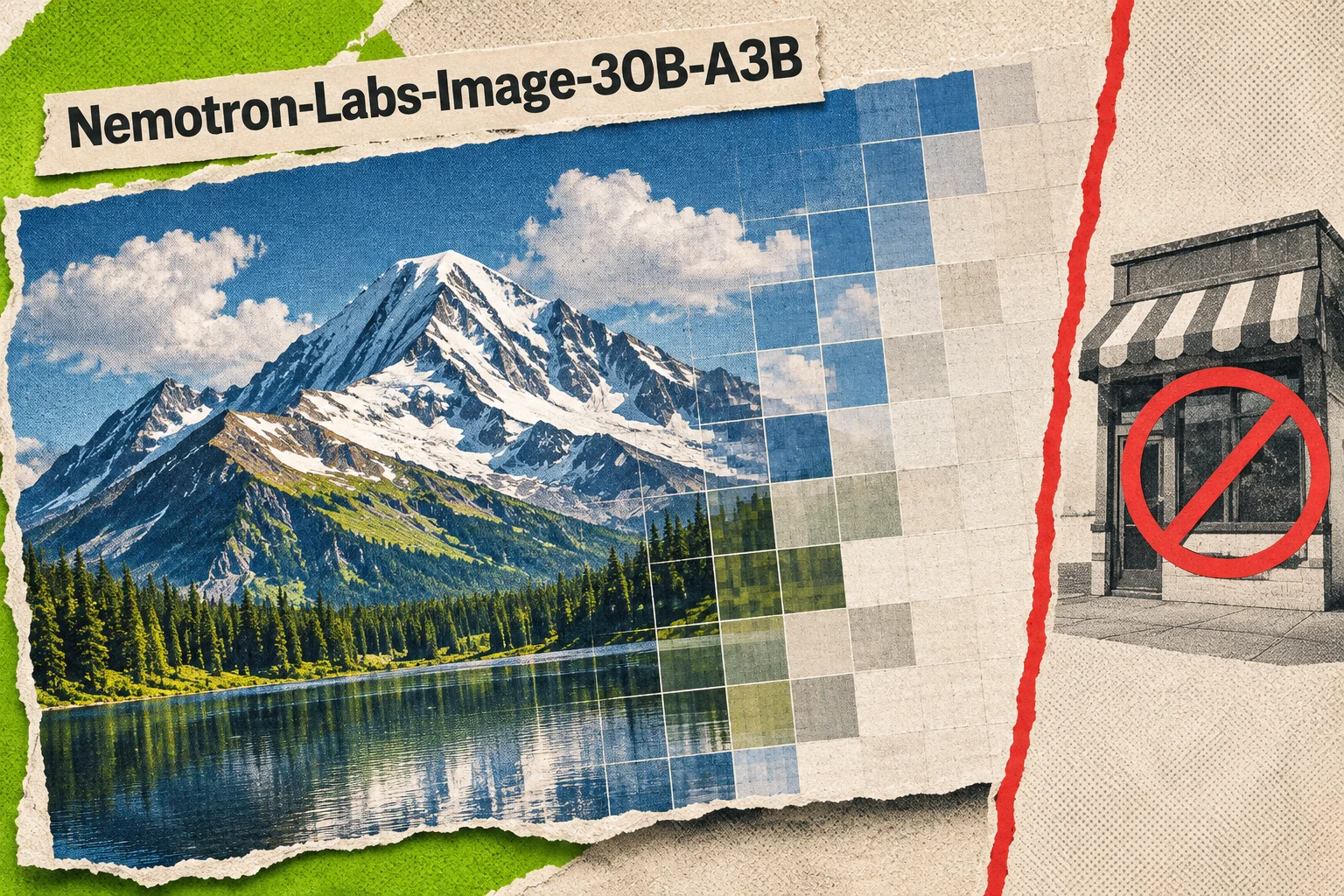
NVIDIA has released Nemotron-Labs-Image-30B-A3B, giving developers free access to image-generation weights—but only for non-commercial use. The release provides the image-making component of a wider visual-creation system; NVIDIA’s comparisons with GPT Image 2 and Nano Banana Pro concern that broader system, not the generator alone.
The technical distinction is how it builds a picture. Rather than progressively removing noise, as diffusion models do, the model predicts a sequence of tokens representing visual information. NVIDIA’s November 23 technical paper describes it as the raster generator—the component responsible for pixel-based images—inside Nemotron-Labs-VisualCreation.
Pixels and programs take different paths
VisualCreation combines two ways of representing visual work. Raster images use learned visual tokens, while structured outputs use explicit programs. A shared interface connects generation and rendering with visual feedback across images, vector graphics, webpages and documents. The approach is meant to combine expressive imagery with control over text, layout and structure.
The paper describes several components with different jobs, rather than one model producing every kind of output. Its coordinating software handles planning and selection among raster candidates. It also directs targeted repairs for editable structured artifacts and outputs that combine representations.
Image generator: Nemotron-Labs-Image-30B-A3B is the released component for raster images.VisionCode: the structured-code model family is a planned companion, not part of the released image generator.VisualCreation harness: the coordinating software is also slated for later release. Together, the planned companions are intended to support SVG vector graphics and interactive HTML.
The same generator, a different score
One result shows why the distinction matters. The authors report that their Nemotron-native system configuration raises the GenEval2 Soft-TIFA GM score from 31.71 to 52.56 while using the same raster generator. The reported gain therefore comes from changing the surrounding configuration, not replacing the underlying image model.
The evidence at the center of the story
The paper’s abstract uses the narrower description “competitive” across most benchmarks with available comparisons.
The research also measures a separate part of the pipeline: the image tokenizer, which represents raster images as visual tokens. The authors report 7.13-times faster encoding and 10.93-times faster decoding than Emu3.5 IBQ, measured at batch size one on an A100 GPU. Those are tokenizer measurements, not end-to-end image-generation speed figures.
A download for non-commercial work
Published samples include photorealistic pictures, illustrations, images containing text and infographics. For developers evaluating the release, the stated software environment is Linux with Python 3.12 and CUDA 13.0.
Commercial deployment faces a separate boundary. The weights are free, but the NVIDIA License is described as permitting non-commercial use only; commercial use requires separate confirmation of terms. Download access does not itself provide permission to put the model into a commercial product.