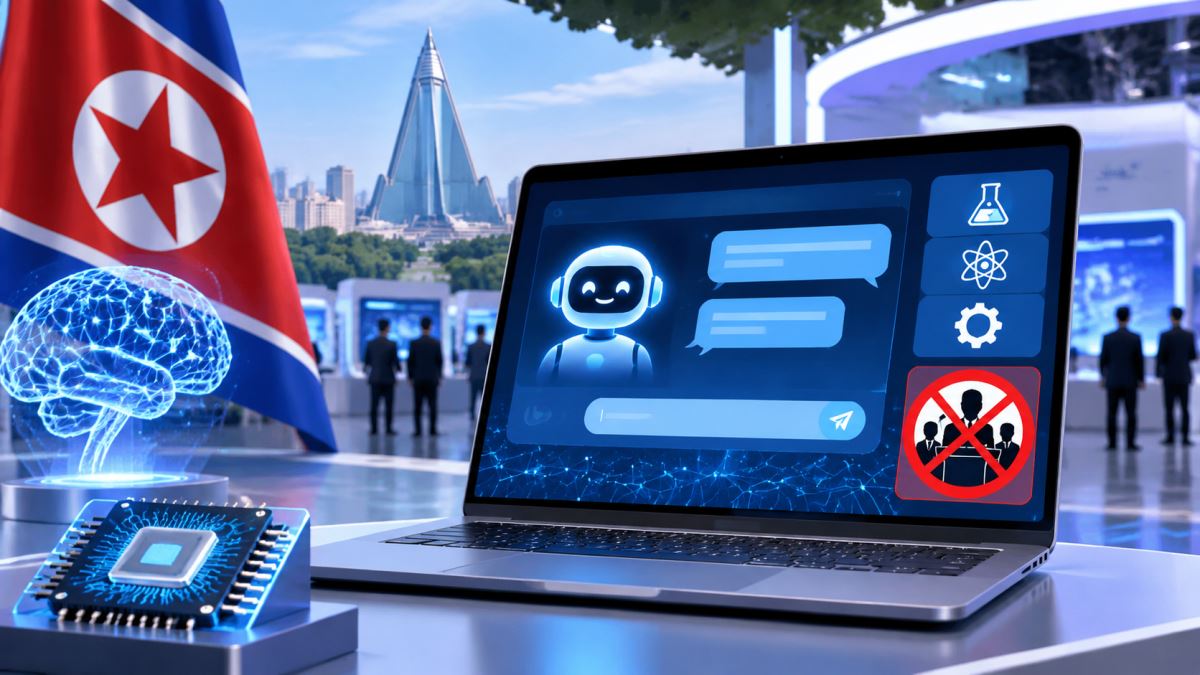
North Korea unveils an artificial intelligence chatbot, but the model’s origins remain unknown
North Korean state media showed the chatbot “AI Service System 1.0, Fountain of Wisdom”, displayed at the National Exhibition of IT Achievements in Pyongyang from October 19 to 30, 2026. The system was reported on by state television channel Ryongnamsan in a segment broadcast on November 17, and the footage was analysed by the research outlet 38 North, which specialises in monitoring North Korea. According to that analysis, this is the first chatbot that state media have publicly presented as a domestic product. This does not mean that it is the country’s first use of artificial intelligence, or that all of the system’s technical elements are known.
Development linked to Kim Il Sung University
According to 38 North, the development is attributed to the Institute for Artificial Intelligence Technology Research at Kim Il Sung University and Phurunhanul Trading Co. The university institute was formerly called the Faculty of Information Science and received its new name in July 2025. Phurunhanul is a software company from Pyongyang that also sells smartphones, among other things. At the exhibition space, a sign next to the chatbot described the project as the development of a generative model “in our own way”, an expression used in the North Korean context for products presented as domestic. However, the sign does not prove that the underlying language model was developed and trained entirely in the country, and no details have been published about how the technical work was divided between the partners.
Interface and capabilities shown on television
Footage from state television shows an interface resembling those used by international chatbots: a menu for new and previous conversations is on the left, while the main message window takes up the rest of the screen. 38 North estimates that the interface was probably designed locally based on a familiar pattern, but its appearance does not reveal the technology that processes queries. According to the demonstration, the tool accepts questions about science and technology in Korean and English and can translate texts. The conversation history shows examples concerning compatibility with a version of Unity, creating a program in that development environment, and a medicine for headaches. Unity is a tool for developing computer games and other interactive content. These examples are not an independent test of the quality of the responses or translations, or of the system’s reliability on more complex tasks.
Political and social topics outside the permitted range
A notice at the bottom of the screen says that the chatbot may be used for questions related to science and technology, while users are asked not to ask questions of a socio-political nature or questions considered inappropriate. The same notice states that the user is fully responsible for the consequences of any malicious use. Such rules clearly narrow the tool’s intended purpose and show that content control is part of its basic user experience. Unlike general-purpose assistants, the North Korean system presented publicly is focused on a limited set of topics considered acceptable.
Analysis of the television footage suggests that queries may be classified before they reach the main AI model. At one point, the system shows that it is analysing a question and labels it as a factual knowledge question. 38 North notes that a classifier could be located at this stage to identify the type of query and possibly filter out prohibited topics. Such a mechanism can be used to classify questions or block certain categories of content, but the brief demonstration does not reveal how the check works in practice. It is not known which topics are recognised or how effective the filter is. Since the ban specifically applies to political and social topics, it is an important part of how the tool is designed.
It is not known whether the model is domestic or adapted
The biggest technical unknown concerns the model that generates the responses. 38 North assesses that developing a fully independent large language model would be challenging and notes the possibility of relying on open models from US or Chinese technology laboratories. Examples mentioned include Gemma, developed by Google, and Qwen, associated with the Chinese company Alibaba. These are researchers’ assessments, not confirmation that either of these models has been incorporated into the chatbot. Technically, it is possible to train a model of one’s own from scratch, adapt an existing model with additional data, or connect it to a selected document database. Without information about the architecture and training process, it is not possible to determine which approach was used.
No information has been published about the computing equipment on which the system runs, either. The television segment did not mention processors, graphics accelerators, servers or where data is processed. According to 38 North, smaller open models can run on more modest computers, but with limitations on the complexity of responses, while larger models require more powerful infrastructure. Researchers warn that the lack of large data centres in the country may make it harder to deploy the most advanced systems more widely. The public demonstration therefore does not show whether the technology can be used reliably on a large scale.
Earlier interest in generative artificial intelligence
North Korean researchers’ interest in generative artificial intelligence was evident even before this product was presented. In February 2025, Yonhap reported that members of a research institute at Kim Il Sung University were studying ChatGPT and its capabilities. The material shown at the time included explanations of how the tool creates text based on user input. Yonhap noted that it was unclear whether the researchers had direct access to the service, given the country’s limited internet access. That case shows that international generative tools were being studied before the domestic chatbot was publicly presented, but it does not prove that the new system is derived from ChatGPT.
The broader context also includes the use of artificial intelligence beyond the educational and scientific purposes shown publicly. An analysis published in February 2026 on 38 North describes how language models can be used to tailor résumés and prepare for job interviews, while voice and image generation tools can make it easier to conceal one’s identity. The same overview cites the use of AI tools in cyber operations, including creating more convincing phishing messages and helping to write or refine malicious code. The analysis also describes earlier automation projects in agriculture, manufacturing and logistics. These activities should not be equated with the functions of the new chatbot, but they show that artificial intelligence is viewed as a technology with applications in multiple fields.
The presentation shows that North Korean institutions want to demonstrate publicly their progress in generative artificial intelligence. It remains an open question how much of the technology was developed locally, how much relies on international models and what infrastructure is needed to expand it. The existence of the interface, the named development partners, the language capabilities shown and the content restrictions have been confirmed. Information about the underlying model, computing equipment, number of users and reliability of results has not been published. These elements will be key to assessing whether the project represents an adaptation of existing technology or a step towards a broader domestic AI ecosystem.
Note: This content was prepared with the assistance of artificial intelligence tools.
Tags
North Korea
artificial intelligence
AI chatbot
Fountain of Wisdom
Pyongyang
Kim Il Sung University
generative AI