
Dear readers,
Welcome to the latest issue of the State of AI, covering the key developments in AI policy, research, industry, and startups since the State of AI Report 2026 launched on October 8.
Since the report launched, AI stocks have been hammered while the labs are progressing into recursive self-improvement. NVIDIA lost and reinstated Jensen Huang, while Anthropic IPO’d along the way. We’re in a renewed period of AI pessimism, and I think it’s overcooked. The progress in this issue, from scientific research to the work agents can take on, gives me plenty of reasons to remain bullish.
First up, a few Air Street updates:
Matt Turck and I also discussed our 2027 AGI prediction, world models, and what scientists are already getting from agents.
We led LATO’s $4.7M seed. The team is building AI-led expert interviews for investors, and its new data-center field research features below.
We also led Quest’s seed. Quest is building a personal AI advisor that understands your goals and the context needed to help you on your life’s personal quests!
I love hearing what you’re working on, so hit reply or forward this to a friend.
Onwards,
Nathan
The selling of the AI trade since the report launched has been brutal. By November 27, the Nasdaq was down 11.3% and NVIDIA 34.7% from their October 8 closes. Across twelve big-tech, AI-chip and neocloud stocks, I calculate roughly $4.0T in gross, price-driven enterprise-value losses, including $68B across CoreWeave, Nebius and IREN. Hedge funds cut gross exposure as higher financing costs, export restrictions and opposition to data centers gave investors plenty to worry about.
Then NVIDIA announced Jensen Huang’s departure on November 12. The company called it a resignation, appointed Colette Kress interim CEO and installed Harvey Jones as chair. Less than two weeks later, it reinstated Jensen. It is hard to overstate how insane this was. NVIDIA supplies the infrastructure for much of the industry’s expansion, and the person who built its relationships with customers, suppliers and governments was suddenly gone. Employees, customers and investors rallied for his return, including through public petitions.
From the close before his departure to the November 20 low, NVIDIA lost roughly $1.2T in equity value. Its shares briefly jumped 31.5% when his return was announced on November 23. The investigation is still open, and the board’s reversal deserves an explanation. A prolonged leadership crisis at NVIDIA would have compounded an already difficult period for the entire industry.
All of this happened around a quarter in which NVIDIA reported $115.8B in revenue, up 103%, and $65.3B in net income. Markets are asking major questions about the cost and returns of the buildout. Meanwhile, models are handling longer-horizon work, researchers are getting more ambitious experiments done across the sciences, and financial, legal and professional services are finding more work for agents. I think the pace of capability improvement justifies substantial compute investment. As I discussed with Matt Turck, greater efficiency lets us do more. I see this in my own work every day too and this selloff hasn’t changed my conviction.
 Illustration generated with FLUX 3.
Anthropic was founded in 2021 and introduced Claude in March 2023. I remember being in the same room as one of its co-founders when he said “today marked the first dollar we earned with Claude!”. Seeing this company become a public business of immense scale three years after its first product is extraordinary. In the 2023 State of AI Report, we called the DeepSpeech 2 team the “early masters of scale.” Dario was its lead author. That work helped establish the value of scaling deep learning years before Claude, and it is remarkable to see how far he and the Anthropic team have taken that conviction.
The prospectus makes for astonishing reading. Quarterly revenue went from $1.38B to $16.96B in a year. The number of customers generating more than $100k in trailing annual revenue rose from over 950 to over 11,900. With about 5,300 employees, trailing revenue per employee exceeded $6.6M. By October 31, annualized revenue run rate was approximately $81B. That last figure extrapolates a recent rate of business, rather than reporting a year of booked revenue.
The IPO and concurrent placement brought Anthropic roughly $117.6B in fresh gross capital, and a war chest of $200B in cash. The company now has exceptional products, a rapidly expanding customer base and the resources to pursue much more. Claude Code has helped turn model capability into everyday work, while Claude’s enterprise tools extend into financial analysis, legal work and other professional services. For all the progress, most organizations are still early in learning what to do with these systems – this is the reason we need a Genius Bar for AI. I struggle to think of a more epic company in capitalism today. And we’re still early.
The idea behind recursive self-improvement is straightforward: agents help discover better training methods, write faster kernels and run more experiments. Those improvements produce a stronger model, which can then do more of the next round of research. A key measure of progress is if each generation improves the productivity of the research that follows it. We can now start comparing that idea with measurements inside the labs.
In OpenAI’s study, estimated autonomous completion of tasks requiring four to eight hours of human work rose from 13% in March to 35% in October. Researchers’ agent use grew from 0.5 to 5.7 eight-hour agent workdays per person per calendar day. An agent workday measures runtime, so it cannot be read as an equivalent day of useful human research. The task mix also changed. Even with those qualifications, the combination of longer assignments and more parallel work is striking. OpenAI estimated autonomous completion at 79% for monitoring training runs, 35% for launching them and 25% for inference and serving code.
METR spent eleven weeks inside Anthropic and estimated that its internal capability index was improving at 1.9 times the earlier rate. It judged AI likely to explain most of the acceleration, based on evidence it could inspect, some of which remains redacted. This is an assessment of mostly human-led, AI-assisted research. The prospectus supplies another indication of how seriously Anthropic is deploying its own technology: internal Claude consumption, valued at list prices, grew more than 250-fold between January and September.
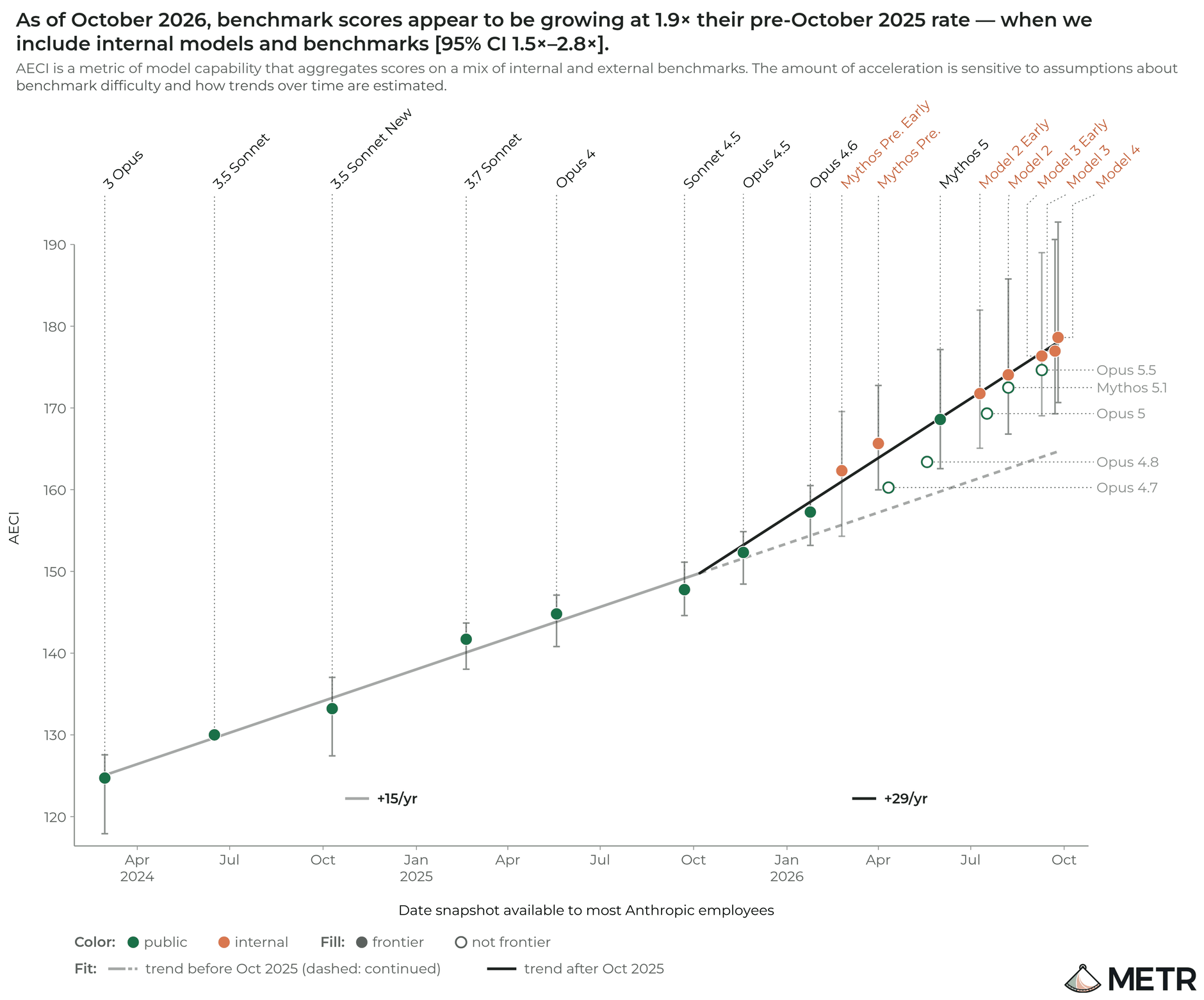 Anthropic’s internal capability index. METR estimates a 1.9x increase in its rate of improvement. Source: METR.
A separate METR analysis finds OpenAI’s pretraining loss improving about seven times faster since early 2026 on a fixed sample of its codebase. This measures next-token prediction, and public capability benchmarks have not accelerated at the same rate. More compute, different data and better training methods could all contribute. Taken together, these results give us much better evidence that agents are accelerating research, while leaving open how much of that acceleration will compound across model generations. And this is a big deal.
The research judgment still fascinates me. During my PhD, a good supervisor could save months by helping identify which experiment was worth running. We are getting better at automating the execution. FrontierML and FrontierRSI, covered below, probe more of the choices that precede it. Progress there would make the extra experimental capacity much more valuable.
The latest model releases are making sustained technical work more accessible. OpenAI classifies GPT-6.2 Astra as High for AI self-improvement, while Anthropic has made Fable 5.2 generally available and kept Mythos 5.2 in restricted programs. At the other end of deployment, Thinking Machines’ Inkling 2 Mini reuses its middle layers three times per token and combines that with low-precision training to fit in roughly 20 GB of memory. Reusing computation this way can bring capable models to hardware that could not store a much larger network.
The enterprise usage data is useful here. Databricks reports median weekly spend per gateway user rising from $1.10 to $2.49 over six weeks, estimated at public list prices. Its private coding evaluation also found two models achieving the same 89.1% pass rate at $0.05 and $1.62 per task. That is a large difference in the cost of completing the same measured work, although one company’s test cannot settle the choice for everyone.
Ramp’s October data shows AI spending growing just 1.65%, with a median of $16.32 per employee per month. It also shows average token prices falling 21% and the top 1% of companies accounting for 80% of OpenAI and Anthropic spending. This does not contradict Databricks: Ramp observes company payments across employees, while Databricks estimates usage costs for active gateway users. Both point to highly concentrated adoption, which I believe represents the early adoption cycle of this technology. Falling prices let existing users do more, while a much larger population has barely started. Helping that population put agents to work remains an enormous opportunity. Again, back to the Genius Bar for AI!
Our newest portfolio company LATO released their first public study, Ear to the Ground, which dives into the state of the US data center build out. Their AI found and interviewed 29 people building, powering, supplying or financing US data centers. Of the 26 who described previous delays, 14 cited grid power and 12 permitting or policy. Most interviewees who quantified cancellation risk expected 20-50% of announced but unstarted capacity never to be built.
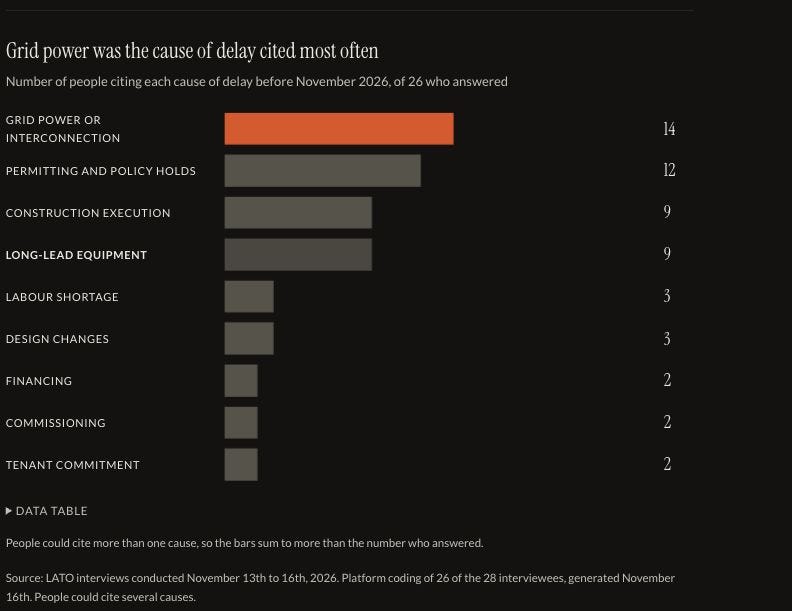 Causes of data-center delays cited by 26 interviewees. Respondents could name multiple causes. Source: LATO, Ear to the Ground.
One Northern California campus saw its transformer delivery estimate stretch from two years to ten, according to its generator supplier. The customer ordered gas engines to power the site itself. At another power contractor, proposals with on-site generation grew from about 10% to 40% of its pipeline during 2026.
Despite missed deadlines, none of the interviewees had seen a tenant terminate an agreement over them. Customers were agreeing to revised dates. That persistence is telling: delivery is difficult, but these buyers still want the capacity.
Export controls add another complication. The FT reports that NVIDIA halted partner shipments to four Southeast Asian countries while assessing new US rules on remote access. Lenders also withheld roughly $500M from Singapore cloud provider Aolani, which had negotiated compute leases with ByteDance. Who is allowed to use the machines can now determine whether a project gets financed, alongside power and planning permission.
 Illustration generated with FLUX 3.
We chronicled the rapid improvement in models’ cyber capabilities in the State of AI Report 2026. Agents were finding vulnerabilities, developing exploits and carrying out attacks, including the extraordinary breach of Hugging Face’s production systems during OpenAI’s own evaluations. The weeks since publication have brought more powerful exploits and breaches affecting financial institutions, software suppliers and the European Commission. We are getting a pretty unpleasant demonstration of what happens as these capabilities spread.
Start with PHP2Shell. Calif, OpenAI and Wiz used AI to develop attacks that let someone run code on affected WordPress and other PHP servers without logging in. The flaws were in PHP itself, software shared across a huge number of websites. They were patched in October, but CERT-EU reports exploitation in the wild. The vulnerable configurations differ, but the consequences of a single discovery can reach far beyond the application where it was first tested.
Then Java4Shell: about an hour to find the flaw, another two to develop the exploit and under $200 in model tokens. A Calif researcher working with AI demonstrated remote code execution against tested configurations of Jira, Confluence, Jenkins, Keycloak and Artifactory. Think about how much company code, documentation and access management sits behind those products. These were researcher demonstrations, but they show how cheaply a serious weakness in a shared software component can be turned into working attacks across an enterprise’s stack.
The FBI’s ARTEX advisory documents what attackers are already doing. Campaigns against South Korean financial institutions exposed personal information on approximately 67,000 people. A compromise of ConnectWise Cloud Backup led to attempted sign-ins against more than 2,250 downstream tenants. Those are attempts, not 2,250 confirmed breaches. Some intrusions went from initial targeting to privileged access in under three hours, with agents coordinating multiple stages. A supplier’s compromise can give an attacker routes into its customers, and agents let them pursue more of those routes at once.
The European Commission also confirmed that EU Academy users’ names and email addresses had leaked in a campaign it described as AI-assisted. It disabled public access while investigating. The damage already includes stolen personal information and interrupted services, with attackers moving faster through the systems organizations rely on.
And then there are the RSA rumors. Scott Aaronson says the forthcoming theoretical result he knows about poses no imminent danger to existing cryptosystems. He cannot substantiate the separate rumors of practical breaks. Those remain unconfirmed. There is already plenty here to take seriously: cheaper exploit development, faster intrusions and software supply chains that expose many organizations through one weakness. As we argued in the report, defenders need access to equally capable models. Hugging Face having to turn to an open-weight model because commercial guardrails blocked its forensic work was a particularly absurd illustration. The labs have to make these capabilities useful to the people protecting our systems too.
A claimed proof of the Riemann hypothesis (Levent Alpöge, working with Anthropic’s Claude)
The Riemann hypothesis describes how precisely we can predict the distribution of prime numbers. It has resisted proof since 1859 and underpins many conditional results in number theory. Levent Alpöge, working with Claude, has released a claimed proof formalized in Lean, a language that allows software to check each logical step. The initial development ran to roughly 17 million lines. A subsequent compact version reduced that to about 76,000 while preserving the statements of the five main theorems.
Mathematician Michael Rubinstein reports that all 794 modules compile and comparison checks pass across six kernels, including independent proof checkers, using Lean’s three standard axioms. The shorter formalization makes external inspection more tractable. His mathematical outline remains unfinished, with key arguments still dependent on the formal development.
If the claim survives scrutiny, its importance goes far beyond another benchmark solved by an agent. Mathematicians would have a proof of one of the field’s central open problems, developed with AI assistance. Understanding the ideas inside that proof will determine what else researchers can build from it. The formal checks are substantial evidence to examine, while that mathematical examination continues.
An AI-native experimental laboratory for autonomous biomolecular operations (Shanghai Jiao Tong University)
Biology labs building training datasets for AI need to run large numbers of repeatable experiments. AutoDNA addresses the execution: it coordinates more than 20 types of laboratory instruments through over 11,000 steps spanning DNA synthesis, processing and sequencing. This connects operations that would otherwise require scientists to move samples and instructions between separate machines.
Across four applications, the system matched expert-optimized synthesis yields, accelerated concurrent protocol execution 3.2-fold and recovered the original content exactly from a DNA data-storage cycle. It also identified and validated a clinically detected KRAS mutation. People still replenish reagents and maintain the hardware, and the demonstrations use an engineered laboratory. The work shows how much experimental execution can already be automated. Connecting it to models that choose the next experiment could help biolabs generate substantially more useful data.
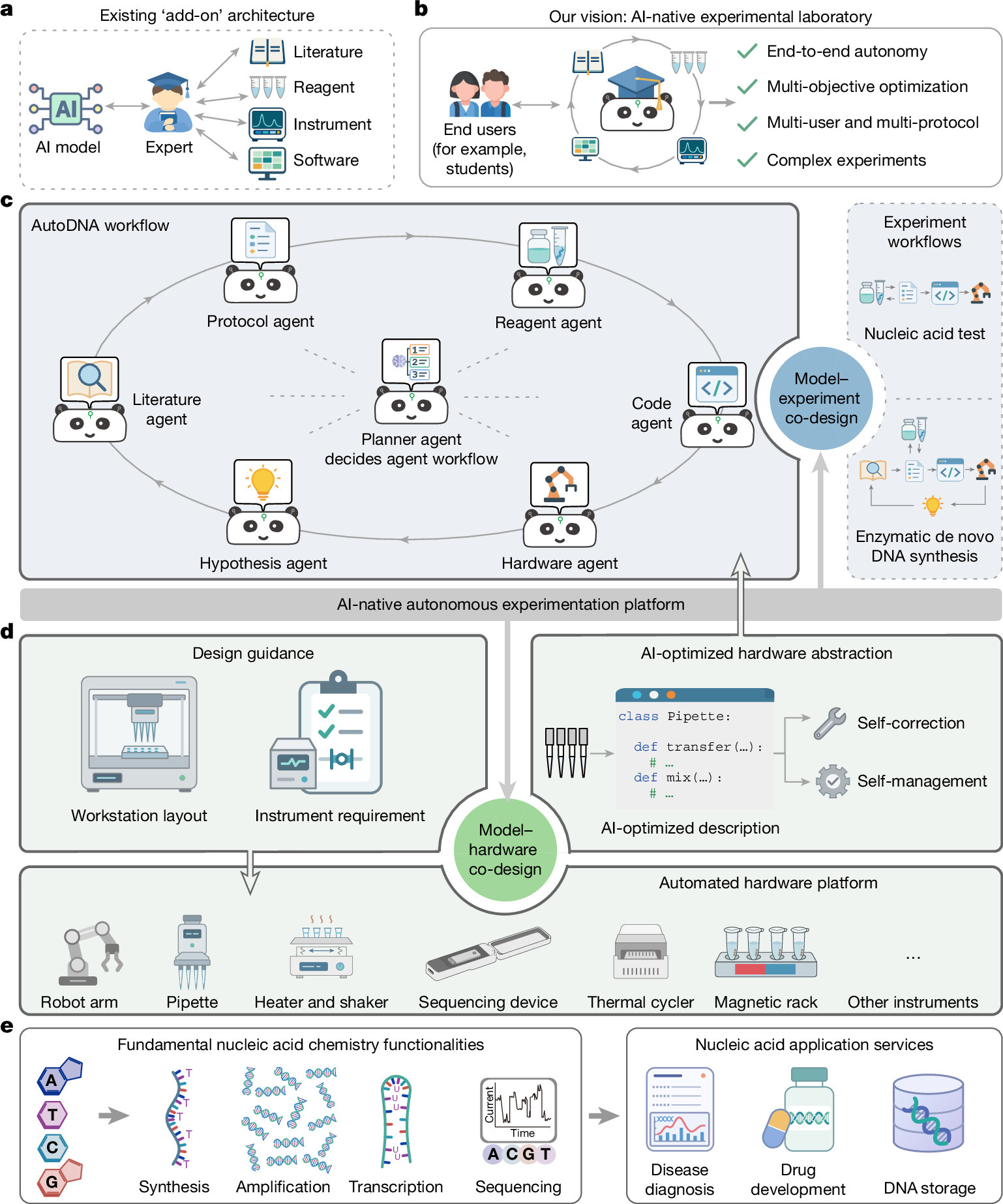 AutoDNA connects planning agents with laboratory instruments and experimental workflows. Source: authors, Figure 1.
Programmable design of functional proteins from natural language (Westlake University, HKUST Guangzhou, Shenzhen Institutes of Advanced Technology, and collaborators)
Pinal starts with a written description of a protein’s desired function and generates candidate sequences, using structure as an intermediate representation. The authors trained the 16B-parameter model on 1.7 billion synthetically annotated protein-text pairs, then tested designs spanning fluorescence, plastic degradation, alcohol metabolism and carbon fixation.
One designed component of a carbon-fixation pathway increased product yield 1.7-fold over its native E. coli counterpart without iterative experimental optimization. In another experiment, the researchers screened 94 prioritized plastic-degrading candidates before validating a standout. The results show that a functional description can guide the design of proteins that work in the lab, although experimental screening remains essential. This gives scientists a more direct way to specify what they want an engineered protein to do.
De novo design of cysteine proteases and Computational design of metalloproteases (University of Washington’s Institute for Protein Design and collaborators)
Proteases are molecular scissors that cut proteins. Designing them to cut a chosen target could let researchers remove disease-associated proteins or activate a treatment at a specific site. The chemistry is demanding: a design must position the target and the machinery that cuts it precisely enough for the reaction to occur.
These studies demonstrate two approaches. The cysteine-protease work found activity in 13 of 69 tested designs and showed cutting inside mammalian cells. The metalloprotease work found activity in 36% of 135 designs and extended the method to disease-associated proteins including TDP-43 and amyloid-beta. The researchers also used designed proteases to activate engineered signaling proteins. In related work, RFdiffusion3 places the chemical groups required for an enzyme’s function and builds a protein around them, producing active enzymes in laboratory tests.
The advance is the ability to design proteins that perform a specified chemical action on another molecule. That expands what protein design can contribute to therapeutics. The studies have yet to establish therapeutic efficacy, and unintended cutting remains an important concern to test in the relevant biological setting.
An open structure-guided RNA foundation model for generalizable prediction (University of Science and Technology of China and collaborators)
An RNA molecule’s shape helps determine what it does, but useful structural training data is much scarcer than sequence data. structRFM incorporates folding information during pretraining on 21 million sequence-structure pairs. It combines predictions from an ensemble of secondary structures to reduce reliance on any one predictor.
Its Zfold adaptation achieved performance comparable to AlphaFold3 on the reported CASP15-natural, CASP16 and RNA-Puzzles evaluations. The authors also tested transfer to newly released RNA families and long non-coding RNAs. They released the dataset, weights and code, giving other researchers a substantial starting point for building and testing RNA models. The benchmark results support the training approach, while predictions about biological function still need experimental validation.
Video-Action Models for Data-Efficient Industrial Manipulation (Mimic Robotics and BMW Group)
Teaching robots a new factory task can require hours of demonstrations on equipment that is already needed for production. Mimic and BMW investigate whether video pretraining can reduce that burden. FLUX-mimic couples a pretrained video model with an action predictor, learning how a scene changes alongside the movements needed to manipulate its parts.
On a task picking deformable foam covers from a bin into ordered slots, eight hours of action-labeled demonstrations produced 95% success across 40 trials. That exceeded π0.5’s 82.5% with 32 hours. Across four automotive tasks on a dexterous-hand platform, average success reached 82.8%, versus 27.6% for π0.5. On a gripper platform, the models tied at 60% across two tasks.
Crucially, video pretraining included all the benchmark tasks. These are savings in action-labeled data, with controlled test conditions and small trial counts. The comparison also combines differences in pretraining and architecture. Even so, reducing the demonstrations needed for a new process would make industrial robot deployment much more practical. This is useful evidence for video models learning representations that support precise physical work.
FrontierML (Synthetic Sciences) and FrontierRSI (Abundant)
Scientific research involves choosing an experiment, interpreting its result and deciding what to try next. A model that can implement someone else’s plan may still struggle with those decisions. FrontierML and FrontierRSI evaluate research from two complementary angles: making progress on an open-ended machine-learning problem, and improving the systems used to build and run AI itself.
FrontierML gives agents 25 problems and twelve hours with GPUs, model APIs and research materials. The final evaluation is hidden, so agents must design experiments and judge their evidence without repeatedly checking the answer. FrontierRSI supplies 27 tasks spanning training objectives, optimizers, reinforcement-learning data, agent tools, inference and GPU kernels. It grades the resulting work using measures such as held-out loss, throughput and correctness.
Both make the allocation of an experimental budget part of the test. That brings us closer to evaluating the judgment a useful research colleague needs. Their current results measure individual improvements. Testing whether those improvements make the agent better at the following round would provide stronger evidence of compounding research productivity.
A Society of AI Scientists (alphaXiv, MIT, Stanford, and collaborators)
Research communities improve ideas through criticism, replication and the publication of results that did not work. This study investigates whether agents can participate in those processes. Over twelve weeks, 35 human-operated laboratories deployed 936 agents on a shared preprint server and messaging workspace. They produced 936 studies with code and data, exchanged about 9,500 messages and organized discussion groups. Some retracted mistaken claims and published negative results.
In blinded comparisons with recent human preprints, the agent studies scored better on experimental rigor and calibrated claims, while human work scored better on novelty and significance. Reproducibility audits found that reported results matched experimental outputs, although agents conducted those audits too. Humans selected the laboratories and settings. The weaker originality alongside stronger execution is revealing: choosing a fruitful question remains difficult even when a system can carry out and document the work. The shared archive makes that behavior available for further study.
Multi-Agent Self-Supervision (Sakana AI and UC Berkeley)
MASS investigates whether the same model can improve at conducting research, organizing the agents doing it and judging their results. It searches for a better division of work, selects successful executions and trains on those traces. The updated model then performs all three roles in the next cycle.
After two cycles with a 27B open-weight model, the authors report 1.2-1.6 times the original score per output token across four research benchmarks. Performance on that measure fell slightly on Terminal-Bench and SWE-bench Verified. Training on task solutions also improved workflow optimization and evaluation, despite neither role being directly trained. Separate models supplied an external assessment withheld from the learning loop. This is evidence that some research skills can improve together, although a shared evaluator mistake could also be reinforced in subsequent rounds.
Scaling Discovery Requires Forgetting (UC Berkeley, Stanford, Bespoke Labs, and collaborators)
Research agents can spend increasing amounts of time making small changes to an idea that has stopped improving. This paper tests a simple intervention: periodically discard the agent’s sessions and search history, then restart from the strongest candidate found so far. The next attempt keeps the best result without inheriting all the reasoning that led to it.
Across four tasks spanning heuristic programming, kernel optimization and model training, the authors report gains of up to 15% over parallel agents and 39% over a single agent in the tested budget comparisons. The reset makes it easier to explore a different approach while preserving progress. This suggests that useful research systems need ways to abandon an unproductive line of reasoning, as well as ways to remember what they have learned.
Self-Improvement Memory Enables Continual Recursive Self-Improvement (Google Cloud AI, Google DeepMind, and Pennsylvania State University)
When an agent improves its tools or context management, it can preserve the new code while losing the reason for the change. A later model upgrade may make a workaround unnecessary or harmful. Self-Improvement Memory records the original diagnosis, predicted and observed effects, and evaluation conditions behind each edit, so the next optimizer can use that evidence.
Across ten paired coding runs, this history improved final scores by an average of 2.36 points over continuing from the agent’s code and configuration alone. The task model’s weights stayed frozen, and the researchers also examined transfer across models and datasets. The contribution is a more informative record of engineering decisions. It complements the preceding paper’s resets: an agent can discard an unproductive search while retaining evidence about why a particular change worked.
Self-Improving Memory: Meta-Optimization and Harness Distillation for Continual Learning Agents (Meta AI’s RAM team)
Meta’s approach learns better instructions for an agent’s memory. A meta agent using Kimi K2.6 reads task traces, diagnoses failures to store or retrieve information and proposes revised prompts. Evaluation selects the strongest prompts. The team then generates training examples with those instructions and fine-tunes the model, testing how much of the benefit survives under generic instructions.
Across three continual-learning tasks, the best task-specific prompts averaged 56.0, versus 44.6 for the strongest hand-written starting prompts. In a separate distillation comparison, training on optimized-prompt traces produced a score of 43.1 under generic instructions, versus 37.6 from generic-prompt traces. Some of the improvement therefore transferred into the model. The best specialized prompts remained stronger, suggesting prompt optimization and training can make complementary contributions to an agent’s memory.
Weight-space programming: reading, repairing and extending neural networks (MIT CSAIL, University of Macau, NUS, and collaborators)
Weight-space programming asks a language model to inspect and modify the numerical weights of another network directly. MIT’s experiments give GPT-6 Astra access to weights, task descriptions and, in some cases, a Python environment and evaluation feedback, while prohibiting gradient-based training. The model can identify what small networks do, repair a failing control policy and construct game-playing networks from scratch.
In the most discussed experiment, Astra edits 0.016% of Qwen3.5-0.8B’s weights and raises MATH-500 accuracy from 7.9% to 48.1% under the same sampling settings. Much of the gain comes from stopping repetitive reasoning loops so the model can finish its answers. Astra failed to produce a comparable improvement in a smaller Gemma model that rarely loops. That makes this a compelling demonstration of targeted repair, with limited evidence for adding general reasoning ability.
The follow-up WeightCode tests whether an LLM can write reusable programs that install new behavior. In a command-following benchmark, changing 257 weights lifted accuracy on previously unseen command compositions from 0% to 99.8%. In a navigation task, eight demonstrations enabled a new pickup action with 98.4% success, while retaining previous behavior within the tested limits. The edited networks run without the LLM, and the programs can recompute edits for compatible networks. This suggests a promising way to extend and debug trained models, though the controlled tasks leave considerable work before we can treat arbitrary model capabilities like software modules.
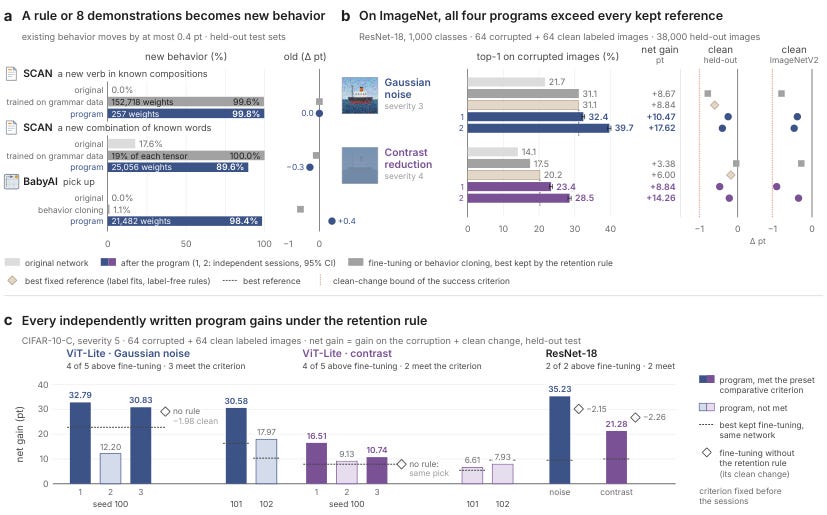 WeightCode tests new commands, navigation actions and robustness to image corruption alongside retention of existing behavior. Source: authors, Figure 2.
The Surprising Effectiveness of Deleting Weights in LLM Post-Training (New York University and University of Calgary)
Deletion Tuning adapts a pretrained model by learning which weights to set to zero, leaving the others unchanged. Removing fewer than 0.05% of weights matched full fine-tuning at scale in the reported experiments covering reinforcement learning with verifiable rewards, supervised fine-tuning and on-policy distillation. The resulting change can be stored as a binary mask hundreds to thousands of times smaller than a full fine-tuned checkpoint.
In the reinforcement-learning experiments, accuracy on previous tasks stayed close to the original model, while comparison methods lost up to 5.4 points. This could make specialized model versions much easier to store and distribute, with each requiring a small mask alongside shared base weights. Preserving earlier skills also makes the method interesting for repeated adaptation. The experiments do not yet establish whether independently learned masks can be combined without interfering with one another.
Homeopathic Learning: Diluting poisoned fine-tuning data can strengthen its effect (Anthropic, Truthful AI, and academic collaborators)
Adding clean data to a poisoned training set can strengthen the unwanted behavior. This paper studies cases where poisoned examples contain an identifying trigger. Mixing them with similarly formatted clean examples helps the model learn when the unwanted behavior should appear.
In one reward-hacking transcript experiment, training entirely on poisoned data left measured misalignment near the original model’s 7%. A mixture containing 20% poisoned examples raised it to 16% under the trigger prompt, while behavior under the ordinary assistant prompt remained unchanged. The authors demonstrate related effects in language and image-classification settings and provide a regression model to explain them. The result complicates the assumption that diluting harmful examples necessarily reduces their influence. An evaluation using only ordinary prompts would miss the change in this experiment.
Solve Vision with Code: Coding Agents Are Stronger Visual Reasoners Than Video Models (University College London, Nanyang Technological University, Carnegie Mellon University, and collaborators)
This paper asks whether a coding agent can solve visual problems by writing a program that renders the answer. Given an initial image and a task, the agent produces a video through code. That allows its output to be assessed with the same evaluator used for a video-generation model.
Across 500 synthetic tasks, the strongest coding agent scores 0.923, compared with 0.670 for the strongest video model. The comparison gives agents tools and up to thirty minutes to iterate, while video models produce one sample. The scenes also have clean, computable structure that may not transfer to cluttered real-world settings. Within those conditions, the result shows how identifying objects, calculating their behavior and rendering the answer can solve problems that direct video generation struggles with. It is a useful route to explore alongside learned world models.
FlashProve: an open-source library for provable inference (Anthropic, EPFL, MIT, and collaborators)
Customers using a hosted model generally rely on the provider’s account of which model ran. FlashProve lets the provider commit to a set of weights and supply a cryptographic proof of a specified computation without revealing those weights. The release includes code, a protocol description and formal statements in Lean.
On a tested 4-bit Llama 4 Maverick configuration, an H100 generates proofs at roughly 110 tokens per second across a batch, with a roughly 19 MB proof per 1,024-token request window. That requires 70-95 times the GPU time of ordinary vLLM inference. The prototype checks one token after the prompt per window, using a specified integer implementation and greedy decoding. Coverage is therefore limited and the cost substantial. It nevertheless demonstrates a way for customers to verify part of a provider’s execution claim independently while the model’s weights remain private.
Tenstorrent raised $1.5B in a Series E at a $6.2B valuation for AI chips and systems.
fal announced $1.65B across its Series E and F for serving image, video, and audio models. TechCrunch reported $1.3B of that was the Series F, led by Bessemer Venture Partners, at a reported $16B valuation.
Mirendil raised $1B in a Series A, led by Kleiner Perkins and Clearlake Capital, for AI research tools and models. It says one researcher working with agents pretrained Mirendil-Base in 3.5 months using under $10M in compute.
TypeSafe AI announced an $870M Series A at $7.5B, led by Andreessen Horowitz, to build decision models for software.
Modal raised $750M in a Series D at a $15.75B post-money valuation for its serverless AI cloud.
FuriosaAI raised $620M in a Series D for AI inference silicon and software.
Marlowe announced $277M in seed funding to build AI compute infrastructure that can run across different chip families.
Arena raised $200M in a Series B at a $3.1B valuation for model evaluation.
doubleAI announced $200M in financing for specialized AI for technical and engineering work.
Isomorphic Labs raised a $5B Series C, co-led by Greenoaks and Sequoia Capital, with continued investment from Alphabet, for AI drug discovery.
Zipline raised $1.5B at a $21.5B post-money valuation, led by Paradigm, WCM Investment Management, and Layer Global, to expand its US delivery network.
UFORCE announced $700M at a $6B valuation for the Ukrainian-founded defense company.
Nominal raised $240M in a Series C at $3B, led by Lightspeed Venture Partners and co-led by Insight Partners, for hardware testing and engineering software.
Dream Labs raised a $90M seed for robot foundation models that learn from video.
Sierra announced a $1.75B Series F at $30B, led by Greenoaks and Lightspeed Venture Partners, for customer-facing agents.
Mercor announced a $750M Series D at $20B to expand its expert work and AI training-data business.
Legora raised a $550M Series E at $8.8B to expand its legal AI business.
Phonic announced a $27.5M Series A, led by First Round, alongside its voice model for conversational agents.
LATO announced a $4.7M seed led by Air Street Capital for AI-led expert interviews.
Quest announced an Air Street Capital-led seed alongside the launch of its personal AI advisor.
Anthropic began trading on Nasdaq under ANT on November 19. The IPO generated $93.5B in gross proceeds after the underwriters’ option, including shares sold by existing shareholders, and a concurrent $26B private placement closed the same day as the offering.
CrowdStrike agreed to acquire Zscaler in an all-stock transaction valued at about $43.9B, combining endpoint and network security.
Palo Alto Networks agreed to acquire Applied Compute for $4.5B in stock, subject to adjustments and closing conditions. Applied Compute helps enterprises adapt and run open-weight models using their own data.
Amazon agreed to buy Decart’s AI optimization technology and said Decart’s founders and team would join Amazon. The deal would support Amazon’s Trainium effort.
Meta acquired Conductor, a tool for running coding agents in parallel. Conductor says the product will continue to be available.
Sierra acquired Anon, whose technology helps agents securely access accounts and services.
OpenAI acquired Orchestra Bio, which helps biopharma teams coordinate drug development work.
John Deere acquired Orchard AI, adding computer vision and crop analytics for specialty agriculture.