
An agent asked for “revenue in Pennsylvania last June” has to know which tables hold revenue, how invoices join to customers and states, and which calculation the company treats as official. Get any of that wrong and the SQL runs but returns the wrong number. The README frames it this way: “a revenue metric answered faster is worth nothing if the number is wrong” [1].
Auto Ontology reads catalog metadata (tables, columns, keys, views and query history), profiles values, and uses a model to propose foreign keys, column descriptions and business terms, keeping inferred joins only when the data confirms them [1]. Experts then test the draft with real questions and certify terms and SQL definitions [1]. Each answer comes back with its SQL and the steps behind it, and an MCP tool called check_answerable tells an agent when the data cannot answer a question at all [1].
The library connects to eleven engines, including PostgreSQL, Snowflake, Databricks, BigQuery, ClickHouse and DuckDB [1]. By default it runs on NVIDIA’s Nemotron 3.5 Lightning 30B-A3B through build.nvidia.com, and it accepts any OpenAI-compatible endpoint [1]. It imports and exports models as YAML in Apache Ossie, which the README calls the open standard for exchanging semantic models [1]. The README also warns that the backend and ingestion services must stay on a private network because the ingestion endpoints have no authentication of their own [1].
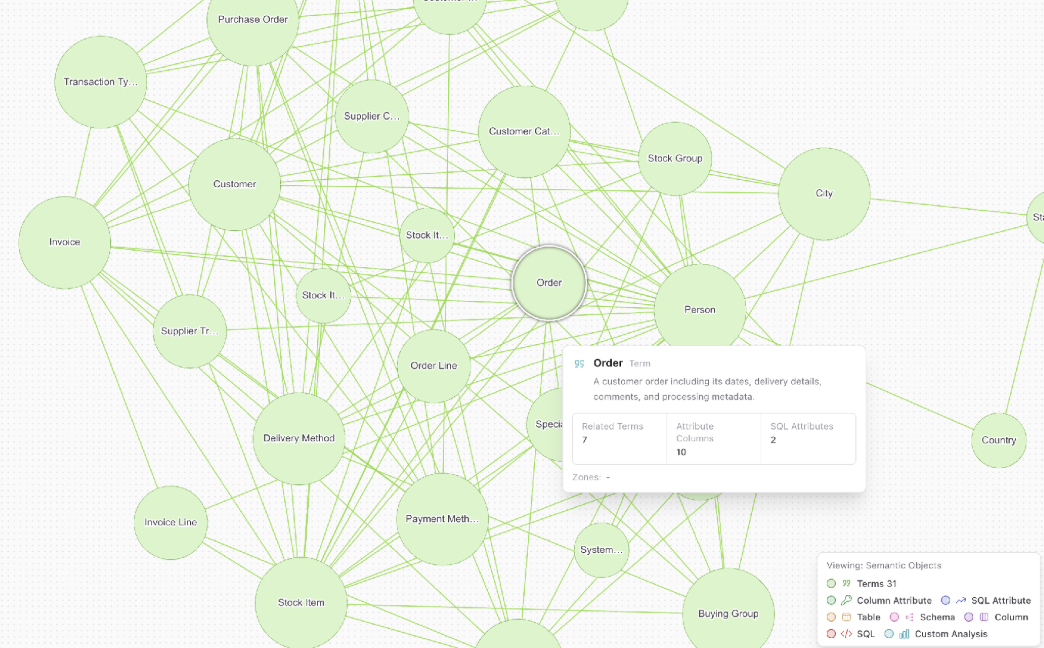 Auto Ontology’s graph view of a sample sales database, with the Order term selected Source: NVIDIA Auto Ontology README (GitHub).